Free AI Tools: Real ROI Without Big Budgets
Discover how free AI tools deliver real ROI for small businesses. Learn implementation strategies, avoid common mistakes, and measure success without big budgets.
Contents
Free AI tools can deliver a genuine return without a big budget or a dedicated IT team; the constraint was never money. It’s knowing which specific, already-costly task to point the tool at. When you do eventually outgrow the free tier, Marathon prices the custom automation that replaces it as a fixed project, from US$450 for a single workflow to US$16,000 for a custom application, so there is a known ceiling on what “graduating” actually costs.
Small businesses that get this right have one thing in common: the right free tools transform daily operations. The key isn’t finding the most advanced AI, it’s identifying tools that solve specific problems you’re already spending time and money on manually.
Understanding True ROI from Free Tools
Return on investment with free AI tools isn’t measured the same way as traditional software purchases. You’re not calculating savings against licence fees. Instead, you’re measuring time recovered, errors reduced, and opportunities created.
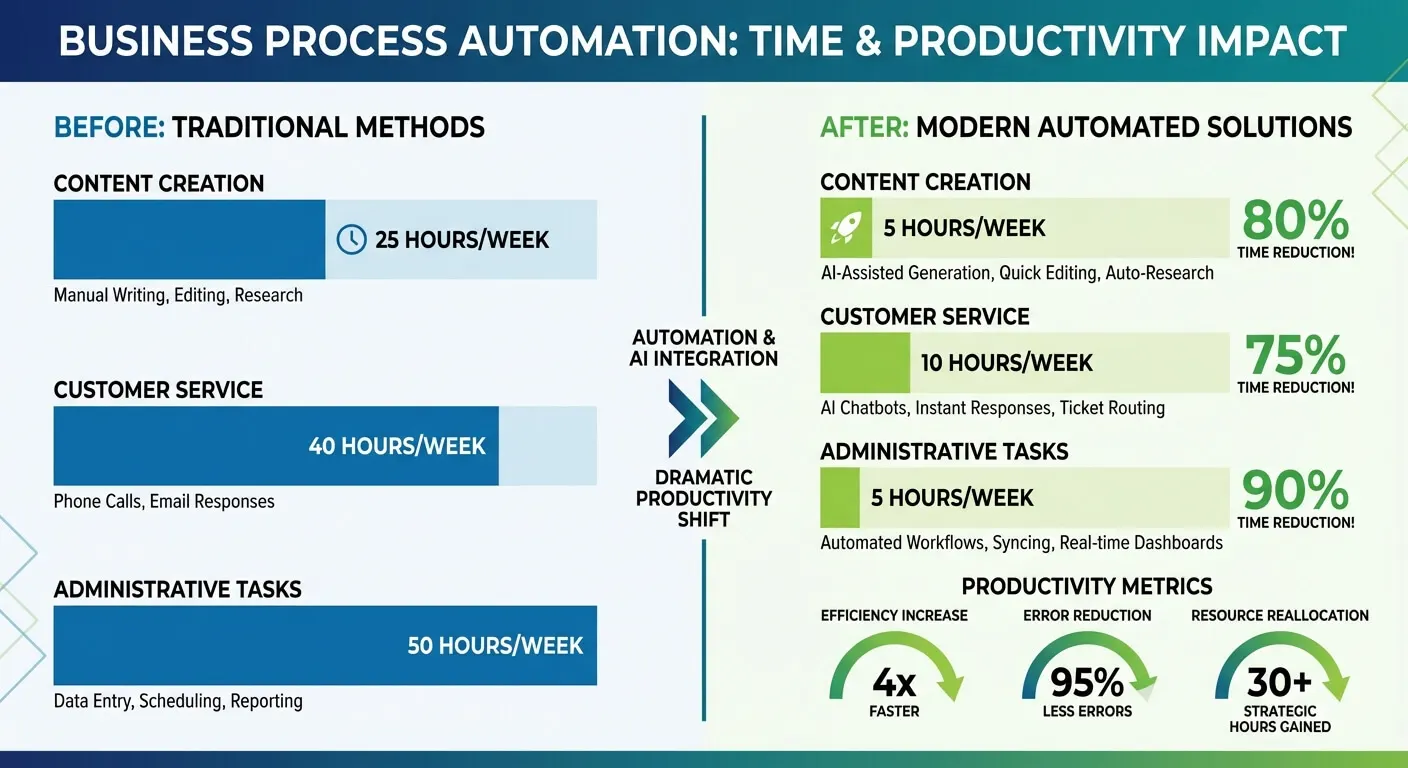
Consider the typical small business owner who spends three hours weekly creating social media content. A free AI writing assistant could reduce this to 45 minutes whilst maintaining quality. That’s 2.25 hours returned every week, or 117 hours annually. If your time is worth $50 per hour, that’s $5,800 in value creation from a tool that costs nothing upfront.
Businesses using AI automation tools, including free options, typically see productivity improvements in automated processes. The study highlighted that small businesses often achieve better relative returns than larger organisations because they can implement changes more quickly.
The calculation changes when you consider compound effects. Time saved on content creation might enable you to respond faster to customer enquiries, potentially increasing conversion rates. The initial time saving creates downstream benefits that multiply the original ROI.
Categories of High-Impact Free AI Tools
Not all free AI tools deliver equal value. Some categories consistently produce measurable returns for small businesses, whilst others remain largely experimental.
Content Creation and Marketing
Free AI writing tools excel at first-draft generation and idea development. They won’t replace human creativity, but they eliminate the blank page problem that costs so many business owners productive hours.
Email marketing presents another opportunity. Free AI tools can optimise subject lines, suggest personalisation approaches, and help structure campaigns for better engagement. One manufacturing client reduced their email campaign preparation time from four hours to 90 minutes by using AI to generate initial drafts and subject line variations.
Customer service automation through free chatbot builders can handle basic enquiries outside business hours. This doesn’t replace human interaction but ensures potential customers receive immediate responses when you’re unavailable.
Data Analysis and Insights
Spreadsheet AI assistants can transform how you analyse business data. Instead of manually creating charts and identifying trends, these tools can process sales data, inventory levels, or customer feedback to highlight patterns worth investigating.
Free AI tools for survey analysis help extract insights from customer feedback without requiring manual review of hundreds of responses. They identify common themes, sentiment trends, and specific issues requiring attention.
Organisations implementing AI-powered data analysis tools have reported faster decision-making cycles, with small businesses experiencing improvements in identifying market opportunities and customer trends.
Administrative Automation
Document processing tools can extract key information from invoices, contracts, or customer forms. This reduces manual data entry errors and speeds up administrative workflows.
Scheduling AI assistants handle appointment bookings, rescheduling requests, and calendar coordination. For service-based businesses, this can eliminate the back-and-forth emails that consume administrative time.
Hidden Costs and Realistic Expectations
Free AI tools aren’t actually free when you factor in implementation time, learning curves, and integration challenges. However, these costs are often lower than businesses expect.
Most free AI tools require 2-4 hours of initial setup and familiarisation. This includes creating accounts, understanding features, and testing with your actual business data. The time investment pays back quickly if the tool addresses a genuine pain point.
Data security deserves consideration. Free tools may have different privacy policies than paid alternatives. Review terms carefully, especially for tools handling customer information or proprietary business data.
Performance limitations exist. Free versions typically have usage caps, fewer features, or occasional service interruptions. Plan for these constraints rather than treating them as unexpected problems.
Integration with existing systems may require workarounds. Free tools rarely offer the seamless connections available in enterprise software. This might mean manual data transfers or duplicate entry until you invest in system integration solutions.
Implementation Strategy for Maximum ROI
Successful AI tool implementation starts with problem identification, not tool selection. Document the manual processes consuming most of your time or causing frequent errors. These become your priority targets.
Start with one tool addressing your biggest pain point. Rushing to implement multiple AI solutions simultaneously often leads to none being properly optimised. Master one tool’s capabilities before expanding.
Measure baseline performance before implementation. If you’re automating email campaigns, track current open rates, click-through rates, and time spent creating campaigns. Without baseline data, you can’t prove ROI.
Set realistic success metrics. A 15% improvement in productivity might not sound transformational, but for a process consuming 10 hours weekly, that’s 1.5 hours returned to more valuable activities.
Create simple workflows that incorporate AI tools naturally. The goal is making AI assistance feel automatic, not adding extra steps to existing processes.
Building on Free Tool Success
Free AI tools often serve as proof-of-concept for larger automation investments. Once you’ve demonstrated ROI from free tools, justifying paid upgrades or custom solutions becomes much easier.
Document what works well and what doesn’t. This information becomes valuable when considering AI automation strategy for business growth. You’ll understand which processes benefit most from AI assistance and where human oversight remains essential.
Many businesses discover that free tools reveal inefficiencies in their current processes. Automating a poorly designed workflow simply makes the problems occur faster. Use AI implementation as an opportunity to streamline your workflows more broadly.
Consider the scalability path early. Free tools that can upgrade to paid versions with enhanced features offer smoother growth trajectories than tools requiring complete replacement as your business expands.
When a free tool hits its limits, custom automation to replace it is priced as a fixed project rather than an open-ended engagement:
| Scope | Example | Fixed project cost |
|---|---|---|
| Single workflow joining two systems | Free chatbot builder replaced with one that writes back to your CRM | From US$450 |
| Multi-step workflow with integrations | Email marketing tool connected to lead scoring and your calendar | From US$1,400 |
| Document or invoice processing pipeline | Free document extraction replaced with a full processing pipeline | From US$2,375 |
| Custom application built around a process | End-to-end system replacing several stitched-together free tools | From US$7,250 |
Common Mistakes and How to Avoid Them

The biggest mistake is treating free AI tools as complete solutions rather than productivity enhancers. They augment human capabilities rather than replacing human judgment. Businesses that remember this distinction achieve better results.
Over-automation represents another common error. Not every repetitive task benefits from AI assistance. Simple processes that already work efficiently might become more complicated with AI involvement.
Neglecting quality control causes problems. AI tools can produce confident-sounding but incorrect outputs. Establish review processes, especially for customer-facing content or important business documents.
Failing to update and maintain AI tools leads to declining performance. Free tools frequently add new features or change interfaces. Regular review ensures you’re maximising available capabilities.
Measuring and Improving Performance
The businesses getting the best return from AI are the ones measuring performance and adjusting, not the ones that adopted the most tools.
Track time-based metrics for tasks where AI provides assistance. Compare completion times, error rates, and quality outcomes between manual and AI-assisted approaches.
Monitor customer-facing improvements. If AI helps with customer service, email marketing, or content creation, measure customer satisfaction, engagement rates, and conversion metrics.
Calculate opportunity cost recovery. Time saved through AI assistance only creates ROI if redirected to revenue-generating activities. Track how recovered time gets reinvested in business growth.
Regularly reassess tool selection. The free AI environment evolves rapidly. Tools that seemed inadequate six months ago might now offer features that transform their utility.
Planning Your Next Steps
Begin with an honest assessment of where manual processes cost you most. This might be administrative tasks, customer communication, content creation, or data analysis. Focus on problems you actually have, not capabilities that sound interesting.
Research 2-3 free tools addressing your primary pain point. Avoid the temptation to evaluate dozens of options. Deep familiarity with fewer tools typically produces better results than surface knowledge of many tools.
Allocate dedicated time for learning and implementation. Treating AI tools as something to explore “when you have time” often means they never receive proper attention. Schedule specific hours for testing and optimisation.
Consider the broader automation journey. Free AI tools can demonstrate value and build confidence, but they’re often stepping stones toward more comprehensive solutions. Understanding this trajectory helps inform current decisions and future planning.
For businesses ready to move beyond free tools, developing a comprehensive strategic consulting approach ensures AI investments align with overall business objectives.
Making Free AI Tools Work for Your Business
The difference between businesses that succeed with free AI tools and those that abandon them often comes down to realistic expectations and systematic implementation. Free doesn’t mean effortless, but it does mean low-risk experimentation with potentially high returns.
Start small, measure carefully, and build on what works. The goal isn’t to automate everything immediately, it’s to prove that AI can solve real problems in your business. Once you’ve established that foundation, expanding your AI capabilities becomes a natural progression rather than a leap of faith.
Free AI tools offer genuine opportunities to recover time, reduce errors, and improve customer experiences without requiring significant upfront investment. The businesses that recognise this advantage and implement tools thoughtfully will find themselves better positioned for future growth, with or without bigger AI budgets.
Frequently Asked Questions
What types of free AI tools deliver the best ROI for small businesses?
Administrative automation and content creation tools typically deliver the most measurable returns. Scheduling assistants, document processing tools, and AI writing assistants address time-consuming tasks that small business owners often handle manually. These tools require minimal technical expertise whilst providing immediate time savings that can be easily quantified and measured.
How long does it take to see ROI from free AI tools?
Most businesses see measurable time savings within 2-4 weeks of implementing free AI tools. Initial setup requires 2-4 hours, but productivity improvements typically become apparent after you’ve used the tool for several business cycles. The key is choosing tools that address genuine pain points rather than experimenting with technologies that don’t solve actual problems.
Are free AI tools secure enough for business use?
Security varies significantly between free AI tools. Review privacy policies carefully, especially for tools handling customer data or proprietary information. Many reputable free tools offer adequate security for general business use, but avoid uploading sensitive financial data, personal customer information, or confidential business intelligence to platforms without verified security credentials and clear data protection policies.
Can free AI tools integrate with existing business software?
Most free AI tools offer limited integration capabilities compared to paid enterprise solutions. Expect manual data transfers or workarounds rather than seamless automation. However, many free tools provide export functions and basic API access that allow determined users to create functional workflows. Consider integration requirements before committing to specific tools for critical business processes.
When should a business upgrade from free to paid AI tools?
Upgrade when you’ve maximised a free tool’s capabilities and can clearly quantify the additional value paid features would provide. Signs include hitting usage limits regularly, needing advanced features for business growth, or requiring better integration with existing systems. Demonstrating ROI from free tools makes justifying paid upgrades significantly easier to stakeholders or financial decision-makers.