

Single workflow joining two systems
From $450
One trigger, one path, no exception handling
We connect HubSpot, Salesforce, Pipedrive and Zoho to your ERP, accounting, support and marketing systems, so every team sees the same customer, for businesses across the UK, US, and Australia. A single CRM integration is a fixed price from $450.
Example workflow
CRM integration is the work of making your CRM agree with the other systems that hold customer data, so a contact, deal or account means the same thing in each. The usual connections are the CRM to accounting so revenue is real rather than forecast, to an ERP so orders and stock inform the account team, to a helpdesk so support history is visible before a renewal call, and to marketing so segments reflect what customers actually bought. Marathon builds these against each platform's API on n8n, which means the matching rules follow your definition of a customer instead of a connector's.
The connection is rarely what makes these projects hard. Agreeing what counts as the same customer is, and so is deciding which system is allowed to be wrong about which field. We settle both before building, and write them down so the answer survives the people who agreed it.
Accounts matched on a stable identifier, orders and credit status visible to the account team, and conflict resolution decided field by field rather than globally.
Invoice and payment status on the account record, so pipeline reporting and revenue reporting stop disagreeing and nobody has to check the ledger by hand.
Direct API work for systems with no ready-made connector, including custom authentication and mapping into custom objects and fields.
Support history and open tickets on the account, so a renewal conversation starts with what the customer has actually been through.
Segments built from what customers bought rather than what they browsed, kept current automatically as deals and invoices change.
The part most projects skip. Matching rules agreed up front, ambiguous records flagged for a human, and no record created on a partial match.
Fixed prices, agreed after a discovery call and before any work starts.
*All prices are listed in US dollars.
From $450
One trigger, one path, no exception handling
From $1,400
Several systems, error handling, notifications
From $2,375
Extraction, validation, approval routing
From $7,250
Bespoke interface, database, user accounts
A $1,400 workflow automating 5 hours a week of staff time pays for itself in 2 to 4 months. Work out yours
Full breakdown: how to calculate true AI automation costs.
Three things. Agreeing what a customer record is, which sounds obvious and is where most projects fail. Building the connections so records created or changed in one system reach the others, in the right direction, without duplicating. And handling the unglamorous cases: merges, deletions, partial matches, and a system being briefly unavailable. The connection is a few days of work; the matching rules are the project.
The ERP normally owns the account, orders and credit position, and the CRM owns the relationship and pipeline. We match accounts between them on a stable identifier rather than company name, push new customers from the CRM into the ERP once a deal closes, and bring order history, balances and credit status back so account managers can see them without asking finance. Which system wins on a conflict is decided per field, not globally.
Yes. If the system exposes an HTTP API we can call it directly, handle its authentication, and map its fields to your CRM. Most CRMs also allow custom objects and fields, so data with nowhere obvious to go still has a home. The genuine blocker is a system with no API and no export at all, and we will tell you early if that is what you have.
HubSpot has a capable API and a good set of native connectors, so we start by checking whether a native one covers you. Custom work is normally about the things HubSpot cannot know: invoice and payment status from your accounting system, product usage, delivery state from an ERP, or support history from a helpdesk it is not connected to. Those become properties on the company or deal so reporting and workflows can use them.
Yes. All four of the CRMs we see most, being Salesforce, HubSpot, Pipedrive and Zoho, expose APIs we build against. Salesforce work tends to be heavier because the object model is richer and the existing configuration usually carries history. We audit what is already there before adding to it.
By deciding the matching rule before writing anything, and by never creating on a partial match. Email is the usual key for people and a registered identifier for companies, with a fallback that flags an ambiguous case for a human rather than guessing. Every workflow also records what it has written, so a retry after a failure updates rather than inserts.
It depends on the field, not the system. Finance data belongs to the accounting system, stock and orders to the ERP, relationship and pipeline data to the CRM, and support history to the helpdesk. Choosing one system to win everything is the shortcut that causes the arguments later. We agree ownership field by field, and write it down.
Yes. Marketing platforms need segments that reflect what customers bought rather than what they browsed, and helpdesks need account context on the ticket. Both are common, both are straightforward once the customer record is agreed, and both are much harder if it is not.
A single two-system connection with a clean matching rule is usually one to two weeks. Anything involving an ERP, historical data that needs deduplicating first, or three or more systems takes longer, and the deduplication is often the largest part. We quote a fixed price after the discovery call, once we have seen the actual data.
A task that takes a member of staff 5 hours a week costs about $10,400 a year, at a staff cost of $40 an hour. Automating it typically saves between half and four fifths of that, so a $1,400 workflow pays for itself in 2 to 4 months and keeps saving after that. Your own payback depends on how often the task happens, how long it takes and who does it. Our free process cost calculator works it out from your numbers, and we calculate it properly before quoting.
Related work: system integration, Xero integration, Shopify integration, and marketing automation.
How a single customer record changes what your team can see and act on.

Connect your CRM and accounting systems for seamless data flow. Eliminate duplicate entry, improve accuracy, and gain complete customer insights with proper integration.
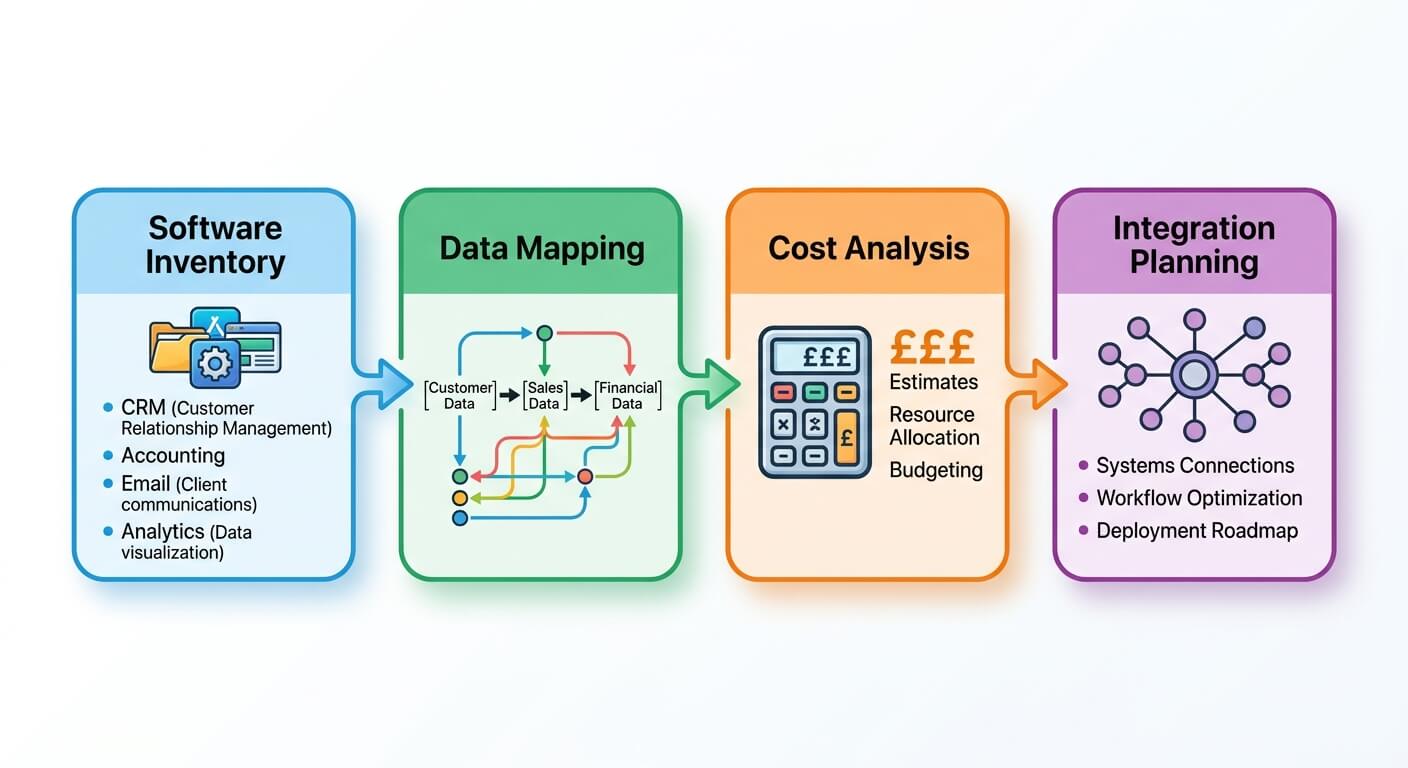
Learn how to integrate business applications and eliminate data silos. Practical steps for SMBs to connect tools, automate workflows, and boost efficiency.

How e-learning consultants integrate LMS platforms with CRM systems for seamless student tracking, plus five costly mistakes to avoid.
Tell us which systems hold customer data today and where they disagree, and we will tell you what is worth connecting.
Book a Discovery Call