

Single workflow joining two systems
From $450
One trigger, one path, no exception handling
We connect Xero to Shopify, Stripe, HubSpot, Salesforce and your inventory system, so sales, payments and stock reconcile without anyone retyping them, for businesses across the UK, US, and Australia. A single Xero connection is a fixed price from $450, and multi-system Xero workflows start from $1,400.
Example workflow
A Xero integration is a connection between Xero and another system, built so that records created in one appear correctly in the other without anyone retyping them. The common cases are sales orders from Shopify becoming invoices in Xero, Stripe payouts reconciling against Xero bank lines, deals in HubSpot or Salesforce carrying revenue back from Xero, and stock levels staying consistent between Xero and an inventory system. Marathon builds these on n8n against the Xero API, so the logic matches how your business actually codes and reconciles rather than how an off-the-shelf connector assumes it does.
The connection itself is rarely the hard part. The work is in the rules underneath it: which record counts as the customer, how a refund is coded, what happens to a partial payment, and which system is allowed to be wrong. We agree those with you before writing anything.
Each of these is a real connection we have built against the Xero API rather than a marketplace listing.
Orders, refunds, fees and payouts posted so the Shopify deposit reconciles against the Xero bank line in one action, as individual invoices or a daily summary depending on your volume.
Charges and refunds grouped to match the payout Stripe actually sends, with fees coded separately so your margin is not quietly understated.
Invoice and payment status carried back onto the deal record, so pipeline reporting and revenue reporting stop telling you different things.
Accounts matched between the two, invoices raised on close, and outstanding balances visible to the account owner without asking finance.
The same patterns built against QuickBooks Online where that is the ledger your accountant works in. Choosing between them is an accounting decision, not an integration one.
Stock kept consistent between Xero and your storefront or warehouse system, with one system owning stock truth rather than both fighting over it.
Start with the Xero marketplace. If an app does what you need, buy it: it is cheaper than anything we would build and it is maintained for you. Custom work earns its place in four situations, being non-standard account coding, a chain of three or more systems, a matching rule the app cannot express, and a process that spans systems no single connector joins. If your case is not one of those, we will point you at the app on the call rather than quote for a build.
Fixed prices, agreed after a discovery call and before any work starts.
*All prices are listed in US dollars.
From $450
One trigger, one path, no exception handling
From $1,400
Several systems, error handling, notifications
From $2,375
Extraction, validation, approval routing
From $7,250
Bespoke interface, database, user accounts
A $1,400 workflow automating 5 hours a week of staff time pays for itself in 2 to 4 months. Work out yours
Full breakdown: how to calculate true AI automation costs.
Each Shopify order is picked up as it is placed or settled, mapped to your Xero chart of accounts, and created as an invoice or a summarised daily sales entry depending on your volume. Payments, fees and refunds are posted so the Shopify payout reconciles cleanly against the Xero bank line. High-volume stores are usually better served by a daily summary than by one Xero invoice per order, and we will say which fits your volume.
Yes. The pattern is the same and QuickBooks Online exposes an equivalent API for invoices, payments and customers. If you are choosing between them, the deciding factor is usually which one your accountant already works in rather than any integration limitation. We build against either.
Xero tracks inventory items but is not a warehouse system, so the right design depends on where stock truth lives. If Xero is the source of truth we sync sales out of your storefront into Xero item movements. If a dedicated inventory or 3PL system is the source of truth we let that system own stock levels and post only the financial effect into Xero. Trying to have both own stock is the usual cause of drift.
It closes the gap between what sales thinks a customer is worth and what finance has actually invoiced. Deals in HubSpot carry the real invoice and payment status from Xero, so pipeline reporting and revenue reporting stop disagreeing. It also removes the manual step of someone checking Xero before a renewal conversation.
Yes. Stripe charges, refunds and fees are posted to Xero and grouped to match the payout Stripe actually deposits, so the bank line reconciles in one action rather than line by line. Fees are coded separately so your margins are not quietly understated.
Yes. Accounts and contacts are matched between the two, opportunities can raise Xero invoices on close, and payment status flows back to Salesforce so account owners can see what is outstanding without asking finance. Matching rules matter more than the connection itself, and we agree those with you before building.
For a low volume of simple, one-directional records, Zapier is a reasonable answer and we will tell you when it is. It struggles with the things accounting work is full of: matching an existing contact rather than creating a duplicate, summarising many orders into one entry, handling refunds and partial payments, retrying a failed post without double-posting, and per-task pricing at volume. We build on n8n, which handles those and can be self-hosted.
We are not usually replacing a marketplace app, we are covering what one cannot do. Xero integration apps are excellent when your process matches theirs. Custom work earns its place when you need non-standard coding rules, more than two systems in the chain, an unusual matching rule, or one process that spans systems no single app connects.
A single connection with straightforward mapping, for example Shopify orders into Xero invoices, is usually one to two weeks. Multi-system chains, multi-currency, or anything involving inventory reconciliation take longer because the edge cases are where the work is. We quote a fixed price after the discovery call.
Every workflow we build records what it has already posted, so a retry does not create a duplicate invoice. Failures raise an alert rather than failing silently, and the record sits in an exception queue with the reason attached until it is cleared. Silent failure in an accounting integration is worse than no integration, so we design against it first.
A task that takes a member of staff 5 hours a week costs about $10,400 a year, at a staff cost of $40 an hour. Automating it typically saves between half and four fifths of that, so a $1,400 workflow pays for itself in 2 to 4 months and keeps saving after that. Your own payback depends on how often the task happens, how long it takes and who does it. Our free process cost calculator works it out from your numbers, and we calculate it properly before quoting.
Related work: accounts payable automation, system integration, and AI automation.
How connected accounting systems remove double entry and keep your numbers straight.

Connect your CRM and accounting systems for seamless data flow. Eliminate duplicate entry, improve accuracy, and gain complete customer insights with proper integration.
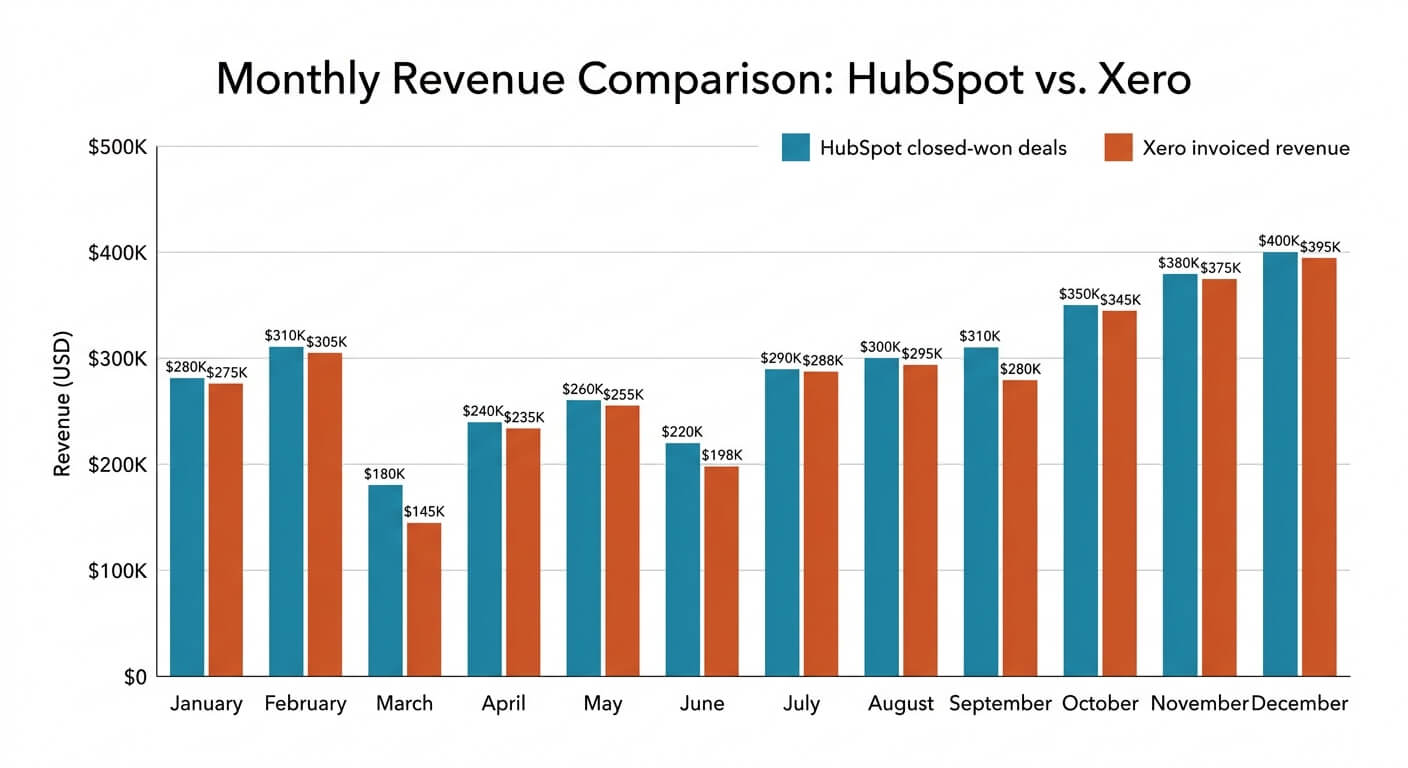
A practical guide to how to connect Xero and HubSpot for accurate revenue reporting, using field mapping, a shared key and weekly reconciliation checks.
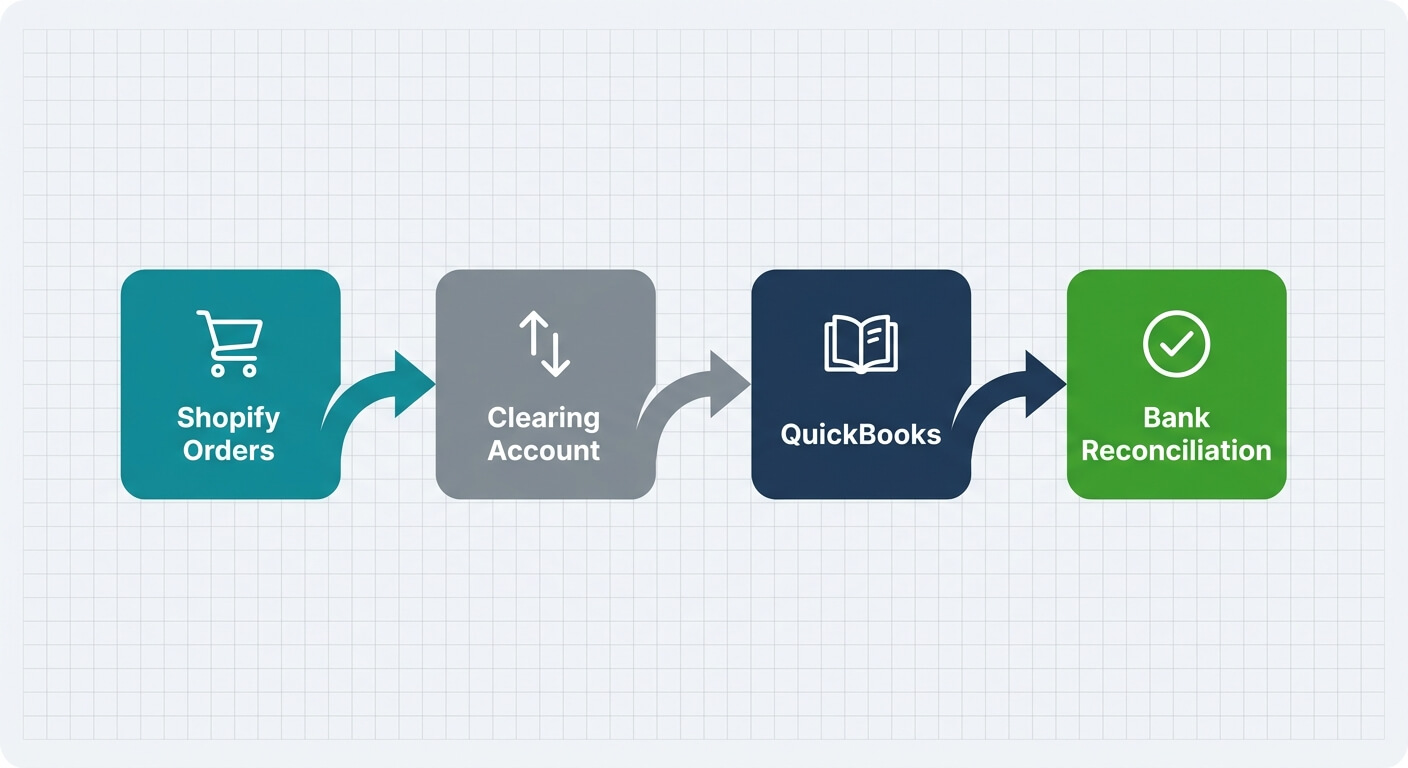
A practical Shopify and QuickBooks integration guide for small retailers: compare four sync options, real costs and setup time, then pick the right one.
Tell us which systems you run and how you code them today, and we will tell you what is worth connecting.
Book a Discovery Call