

Single workflow joining two systems
From $450
One trigger, one path, no exception handling
Eliminate data silos and manual data entry by integrating your CRM, ERP, databases, and business tools into seamless automated workflows, working with businesses across the UK, US, and Australia. A single integration between two systems is a fixed price from $450.
Example workflow
Most of that duplicated work has a price attached, and almost nobody has worked it out. Our process cost calculator will, from three numbers you already know.
Most businesses run on disconnected tools. Data lives in silos, teams duplicate work, and opportunities slip through the cracks. We connect everything so your business runs as one.
Connect your CRM, accounting, marketing, and operations tools so that when data changes in one system, it flows everywhere else automatically.
No more manual exports, imports, or copy-pasting between systems. Data syncs instantly across all connected platforms the moment a change is made.
Take human error out of data entry completely. Automated sync keeps records consistent and accurate across every connected tool, in real time.
Teams typically spend a significant chunk of their week on manual data tasks. Integration removes that overhead entirely so they can put their time into real work.
We connect virtually any business system with an API or data export capability.
Salesforce, HubSpot, Pipedrive, Zoho, and more. Sync contacts, deals, and activities with your other business tools automatically.
Xero, QuickBooks, Sage, FreshBooks. Automate invoice creation, payment tracking, and financial reporting across systems.
Mailchimp, ActiveCampaign, Klaviyo, Google Ads. Sync subscriber data, trigger campaigns, and track attribution automatically.
Airtable, Google Sheets, MySQL, PostgreSQL, MongoDB. Connect your data sources to create a single source of truth.
Shopify, WooCommerce, Stripe, PayPal. Sync orders, inventory, and customer data between your store and backend systems.
Have a proprietary system or legacy software? If it has an API or data export, we can connect it to your modern stack.
Fixed prices, agreed after a discovery call and before any work starts.
*All prices are listed in US dollars.
From $450
One trigger, one path, no exception handling
From $1,400
Several systems, error handling, notifications
From $2,375
Extraction, validation, approval routing
From $7,250
Bespoke interface, database, user accounts
A $1,400 workflow automating 5 hours a week of staff time pays for itself in 2 to 4 months. Work out yours
Full breakdown: how to calculate true AI automation costs.
A methodical approach that ensures reliable, maintainable integrations.
We map your tech stack, identify data flows, and pinpoint where disconnection causes problems or manual work.
We architect the integration, defining data mappings, sync frequencies, error handling, and system communication.
Using n8n or custom APIs, we build the connections, map your data fields, and test everything thoroughly before deployment.
We set up monitoring, alerting, and logging so you know everything is running properly at all times. Ongoing support included.
Common questions about system integration
We can integrate virtually any system that has an API, webhook capability, or data export function. This includes CRMs (Salesforce, HubSpot, Pipedrive), accounting software (Xero, QuickBooks), marketing platforms, e-commerce systems, databases, and custom or legacy applications.
Simple two-system integrations can be completed in 1-2 weeks. Complex multi-system integrations with custom logic typically take 4-8 weeks. We'll provide a clear timeline during your discovery call based on your specific requirements.
No. We build and test integrations in staging environments before deploying. Go-live is typically seamless, and we can run parallel systems during transition if needed. Your operations continue uninterrupted throughout the process.
We build robust error handling, retry logic, and monitoring into every integration. If issues occur, we're alerted automatically and can respond quickly. Our maintenance packages include ongoing monitoring and support to keep everything running smoothly.
Yes. If your legacy system has any form of API, database access, or file export capability, we can typically integrate it. We've connected decades-old systems to modern cloud platforms using custom middleware and data transformation layers.
Zapier works well for simple, linear automations between popular apps. Custom system integration handles complex logic, high data volumes, legacy systems, and scenarios where Zapier's per-operation pricing becomes unworkable at scale. We use n8n for most integrations, which supports self-hosted deployments, full JavaScript logic, and no per-operation fees.
Yes. For integrations requiring custom logic, real-time webhooks, or direct database access, we build bespoke API connections without relying on third-party automation platforms. This gives you full control over the integration, no vendor dependency, and no additional subscription costs.
API integration is the technical mechanism: connecting two systems via their APIs. System integration is the broader outcome: ensuring your business tools work together as a cohesive whole, with data flowing correctly, errors handled, and processes triggering across platforms. API integration is one part of system integration.
A task that takes a member of staff 5 hours a week costs about $10,400 a year, at a staff cost of $40 an hour. Automating it typically saves between half and four fifths of that, so a $1,400 workflow pays for itself in 2 to 4 months and keeps saving after that. Your own payback depends on how often the task happens, how long it takes and who does it. Our free process cost calculator works it out from your numbers, and we calculate it properly before quoting.
Connected systems unlock the full potential of automation. See our AI automation, accounts payable automation, and process optimisation services.
How connected systems remove double entry and keep your numbers straight.
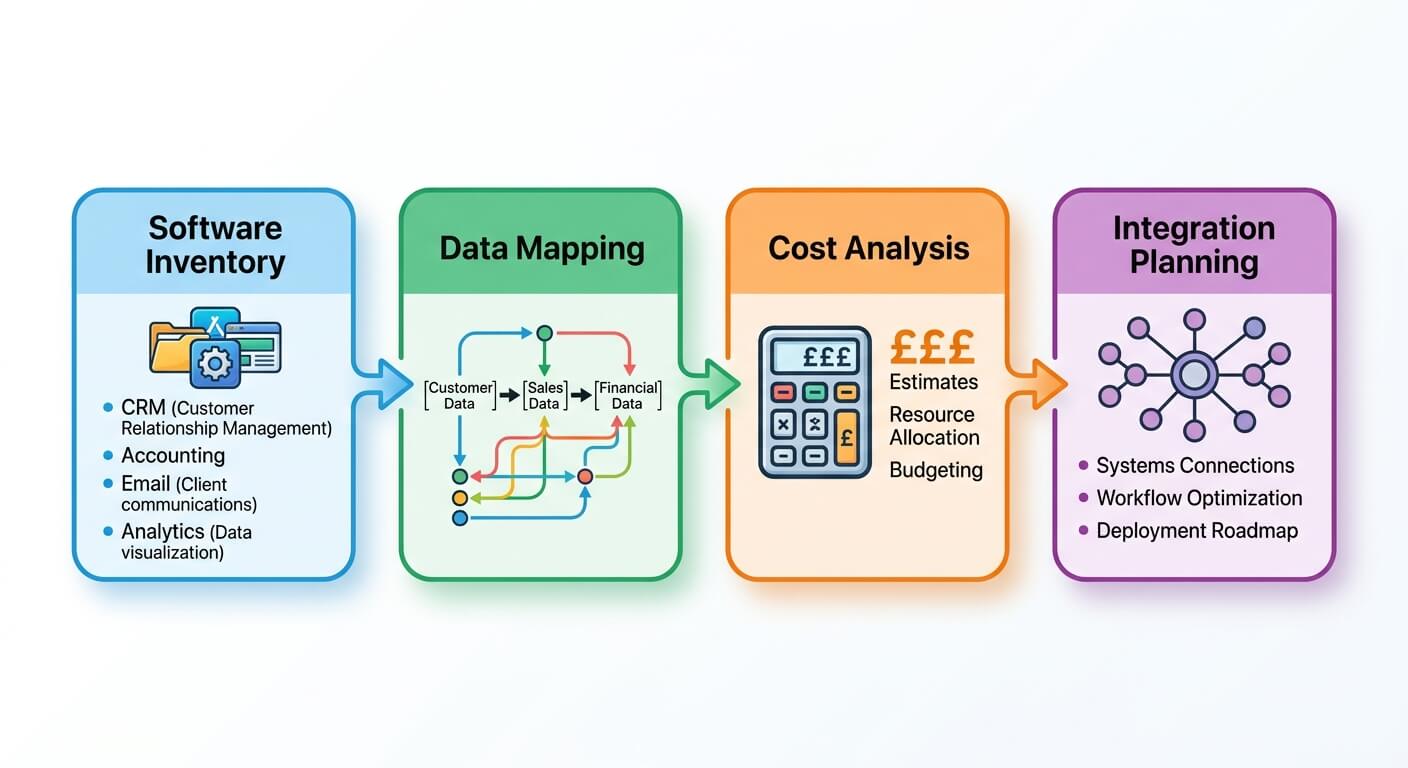
Learn how to integrate business applications and eliminate data silos. Practical steps for SMBs to connect tools, automate workflows, and boost efficiency.

Connect your CRM and accounting systems for seamless data flow. Eliminate duplicate entry, improve accuracy, and gain complete customer insights with proper integration.

Learn how connecting Xero and Shopify eliminates manual inventory updates, reduces stockouts by up to 30%, and gives retailers real-time financial visibility.
Let's discuss how integration can eliminate manual work and unify your business operations.
Book a Discovery Call