Half of AI Automation Jobs Pay Under $500. Here's What the Data Actually Shows
Original research from 8,228 Upwork postings shows half of AI automation jobs pay under $500, and AI work pays more per hour than web development, not less.
Contents
AI automation work pays a premium by the hour and almost nothing by the project. The median hourly ceiling is $40, above web development’s $35. The median fixed-price job is $400. At that hourly rate, $400 buys about ten hours.
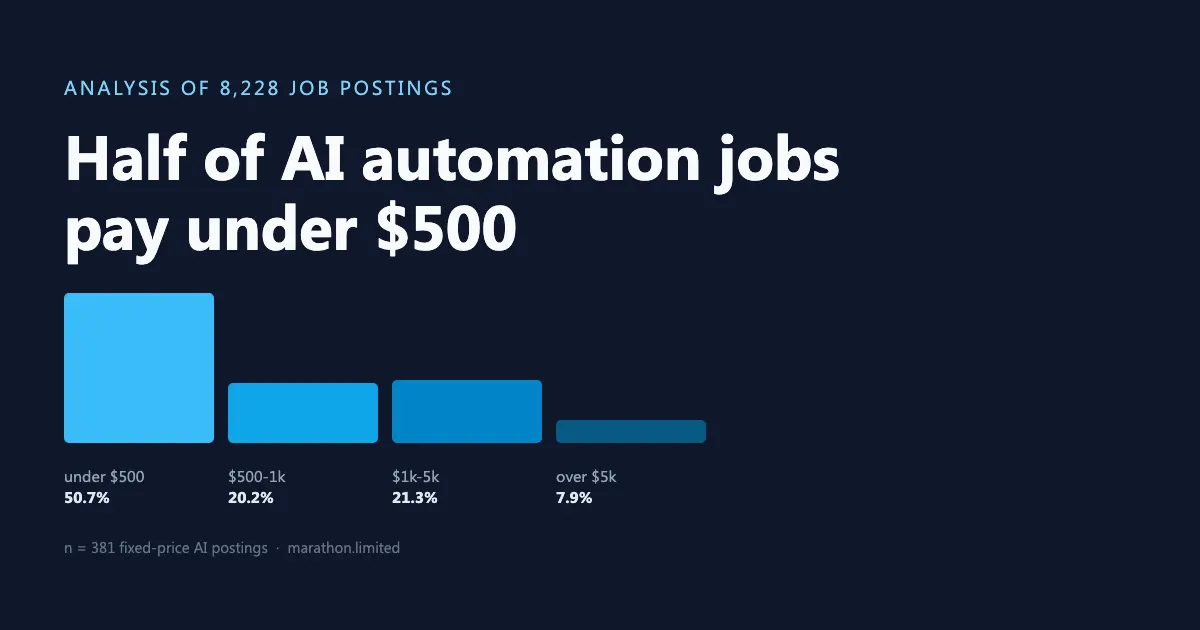
Ten hours is a proof of concept. It is not a system that changes how a business runs. Half of the AI automation jobs posted on Upwork pay under $500, and only 7.9% pay more than $5,000, which means this market is mostly buying experiments rather than transformations. That is the finding, and it is not what most people selling AI automation want to hear.
I run an automation agency, so this research isn’t neutral. The typical hourly rate for specialist automation work is $150, and this is me checking what the market actually pays before I tell anyone else what to charge in theirs.
The headline finding
Within the two AI-specific categories in the dataset, AI & Machine Learning and AI Apps & Integration, there were 381 postings with a fixed-price budget. Here’s how they broke down:
- Under $500: 193 postings, 50.7%
- $500 to $1,000: 77 postings, 20.2%
- $1,000 to $5,000: 81 postings, 21.3%
- Over $5,000: 30 postings, 7.9%
Fixed-price AI automation budgets on Upwork, both AI categories combined. Based on 381 job postings.
That’s the shape of the market. These are small jobs: a script, a chatbot tweak, a single integration. If you’re pricing an AI automation business against the average job on this platform, you’re pricing against a market where most of the work is small.
The counterintuitive finding: AI pays more per hour, not less
I expected AI work to be underpriced against more established categories like web development, because “AI” gets attached to a lot of low-effort postings by clients who don’t yet know what they’re asking for. The data says the opposite.
Median hourly rate ceiling by category:
| Category | Median fixed price | Median hourly ceiling |
|---|---|---|
| AI & Machine Learning | $400 from 206 jobs | $40 from 261 jobs |
| AI Apps & Integration | $500 from 175 jobs | $40 from 207 jobs |
| Web Development | $500 from 1,335 jobs | $35 from 1,309 jobs |
| Scripts & Utilities | $267.50 from 486 jobs | $40 from 527 jobs |
| Mobile Development | $800 from 167 jobs | $35 from 101 jobs |
| Data Extraction / ETL | $200 from 121 jobs | $25 from 79 jobs |
Median hourly rate ceiling by category. Green bars are the two AI categories, grey bars are the rest.
The two AI categories both post a $40 median hourly ceiling. Web development, the largest category in the dataset by a wide margin at 1,309 postings, posts $35. Mobile development also comes in at $35. Data extraction and ETL work is the lowest at $25. AI work is not the cheap end of this market. It sits above web development on an hourly basis, and that finding isn’t softened just because it cuts against the “AI is a race to the bottom” story.
On fixed-price work the picture is more mixed: mobile development has the highest fixed-price median at $800, ahead of AI Apps & Integration ($500) and Web Development ($500), with AI & Machine Learning slightly behind at $400. Scripts & Utilities and Data Extraction/ETL sit lowest on fixed price, at $267.50 and $200.
No trend over six months
The monthly figures show whether AI hourly rates moved over the collection period.
Monthly median hourly ceiling, both AI categories combined:
| Month | Median hourly ceiling | Jobs counted |
|---|---|---|
| March | $40 | 97 |
| April | $40 | 56 |
| May | $47.50 | 70 |
| June | $40 | 106 |
| July | $40 | 80 |
| August (partial, to 20th) | $50 | 40 |
Monthly median hourly ceiling, AI categories combined. August is partial, to 20 August. February is omitted because only 15 postings fell in it, too few to report.
There’s no consistent direction here. May and August are higher, April sits at the same level as March, June and July. This isn’t a rising or falling market over the six months measured. It’s a market that moves around a $40 midpoint without a clear trend either way, and that isn’t a story worth reading into six data points.
Methodology
I collected 8,228 job postings from Upwork, spanning 21 February 2026 to 20 August 2026. Every posting is public: this is what clients wrote when they listed the job, not a survey and not anyone’s self-reported earnings.
Of the 8,228, 2,865 postings carried a fixed-price budget and 2,869 carried an hourly rate range. The remaining 2,494 postings, 30.3% of the total, gave no pay information and are excluded from every figure in this article. A further 100 postings had no recorded posting date and are excluded from the monthly breakdown. That leaves an analysable sample of 5,734 postings for the pay figures.
“Budget” here means the single fixed-price figure the client attached to the job, not a negotiated range or the amount actually paid on completion. “Hourly ceiling” means the top end of the hourly rate range the client posted, not what the freelancer who won the job ended up billing. I have no data on what was actually paid, who won each job, or how many hours a project ran.
Every figure in this article is shown with the number of job postings it was calculated from, so you can judge how much weight it carries. Any slice with fewer than 30 postings is left out of the findings rather than reported as if it meant something. Every other figure above rests on at least 40 postings.
The limits are real. This is one platform, not the whole freelance market.
What this means if you’re hiring
If you’re a business looking to hire someone for AI automation work, the middle of this market is cheap. That price band covers small jobs: a single script, a basic integration, a proof of concept. If your project is genuinely that small, this is a reasonable market to shop in.
If your project is more than that, one that actually changes how your business runs, expect to pay more than the median. The postings above $5,000 are a small slice of this market, and that’s roughly where the work that’s worth having tends to sit.
What this means if you’re selling
If you sell AI automation services, this data should sober you up a little. A large share of your potential competition on Upwork is quoting at that same low price point. You cannot out-cheap that end of the market and you shouldn’t try.
The hourly figures are the more useful number here, and $40 is still a long way from $150. The gap between the median job on this platform and what a specialist should charge isn’t a pricing problem to fix. It’s a signal about which slice of the market you should be competing in, and it isn’t the median job.
So the AI gold rush, at least on this platform, is real for the platform and thin for the practitioner. Demand is high, hourly rates hold a premium, and the projects are small enough that the premium barely matters. Ten hours at $40 is $400, and $400 does not change a business.
The practical consequence is that the median job on Upwork is not a market to compete in, it is a market to be visible in. The 30 postings above $5,000 are where the work that justifies a specialist actually sits, and they are 7.9% of what gets posted.
I would rather tell you the market is smaller and harder than it looks than sell a story about AI automation being a licence to print money. If you are hiring, that means the cheap end will buy you a script and not a solution. If you are selling, it means competing on the median job is a losing position no matter how good you are.