Tech Stack Audits to Unify Systems for Professional Services
Discover how tech stack audits reveal hidden costs in professional services and learn proven strategies to unify fragmented systems for improved efficiency.

Contents
A professional services firm running client management in one system, project tracking in another, invoicing in a third, and time recording in a fourth is not efficient, however well each tool works alone. A tech stack audit finds out what that fragmentation actually costs.
I’ve worked with countless firms where talented professionals spend more time wrestling with technology than serving clients. The irony is painful. These are businesses built on expertise and relationships, yet their own systems prevent them from doing what they do best.
A tech stack audit reveals the true cost of this fragmentation. Not just the obvious expenses like duplicate subscriptions, but the hidden drain on productivity, the client service delays, and the mounting frustration that drives good people to consider other careers.
The Real Cost of Fragmented Systems
Most professional services firms underestimate how much their disconnected systems actually cost them. This pattern has a name: software sprawl, the organic accumulation of tools that nobody planned and nobody owns. The average small business now runs 87 different software applications, and firms using more than 15 disconnected tools lose real productivity to context switching and manual data transfers between them.
That becomes personal when you see it in action. A project manager starts their day checking three different platforms just to understand what happened yesterday. They export data from the project management tool, manually input client hours into the billing system, then update the CRM with project status. By the time they’ve finished the administrative circuit, an hour has vanished.
The same pattern plays out in a single client interaction. A customer calls asking about the status of their order. Staff check the CRM for customer details, the inventory system for stock levels, and the shipping platform for delivery updates. What should take two minutes becomes eight. Multiply that across a team of professionals, factor in the inevitable errors that creep in during manual transfers, and the client communication delays when information gets trapped in the wrong system, and the numbers quickly become sobering.
Operational inefficiencies, including system fragmentation, can cause professional services firms to lose out on potential revenue. These losses aren’t abstract. They represent client opportunities missed, projects delayed, and team members staying late to complete work that should have been automatic.
The human cost often exceeds the financial one. Skilled professionals joined your firm to solve complex problems and build client relationships. Instead, they find themselves becoming data entry clerks, copying information between systems that should talk to each other seamlessly.
What a Comprehensive Tech Stack Audit Reveals
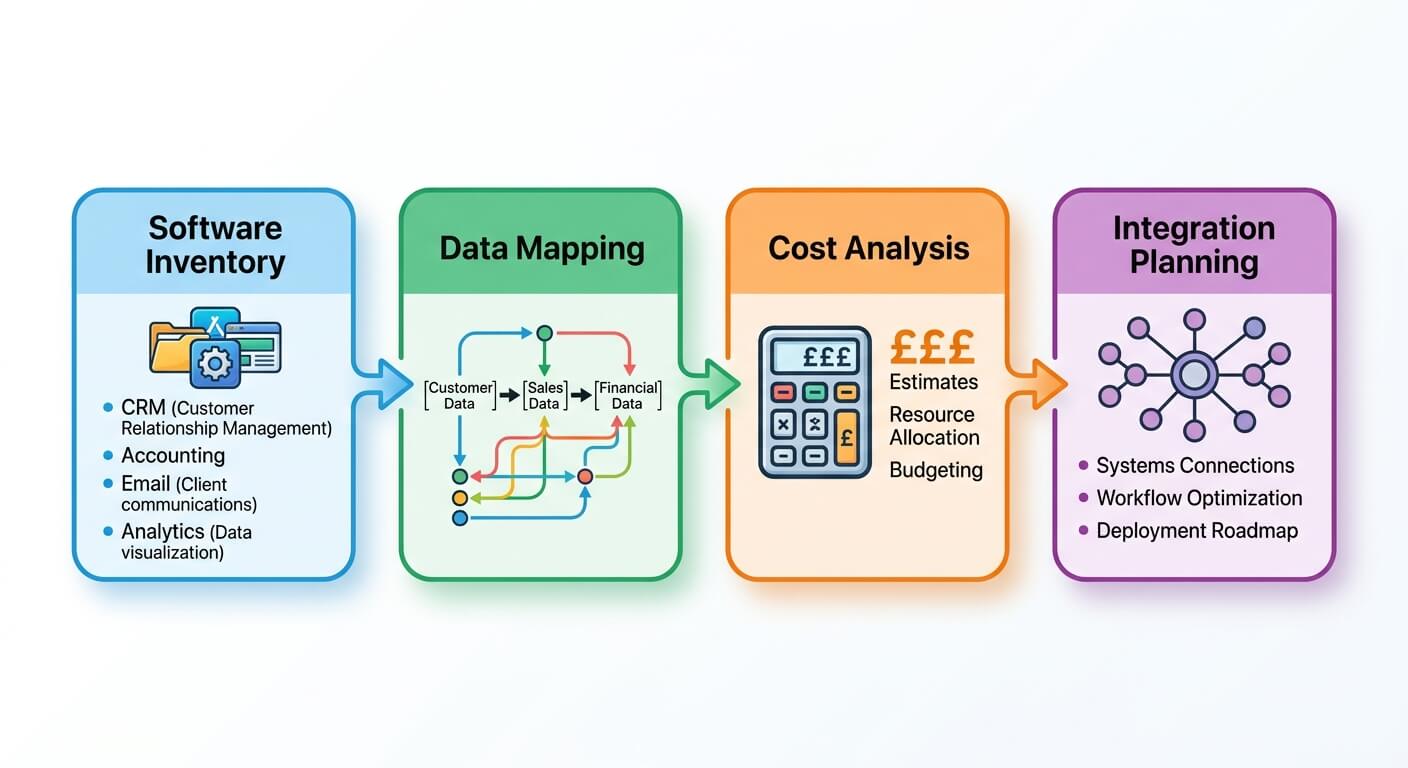
A proper tech stack audit goes beyond cataloguing your software subscriptions. It maps the actual flow of information through your business and identifies where that flow breaks down.
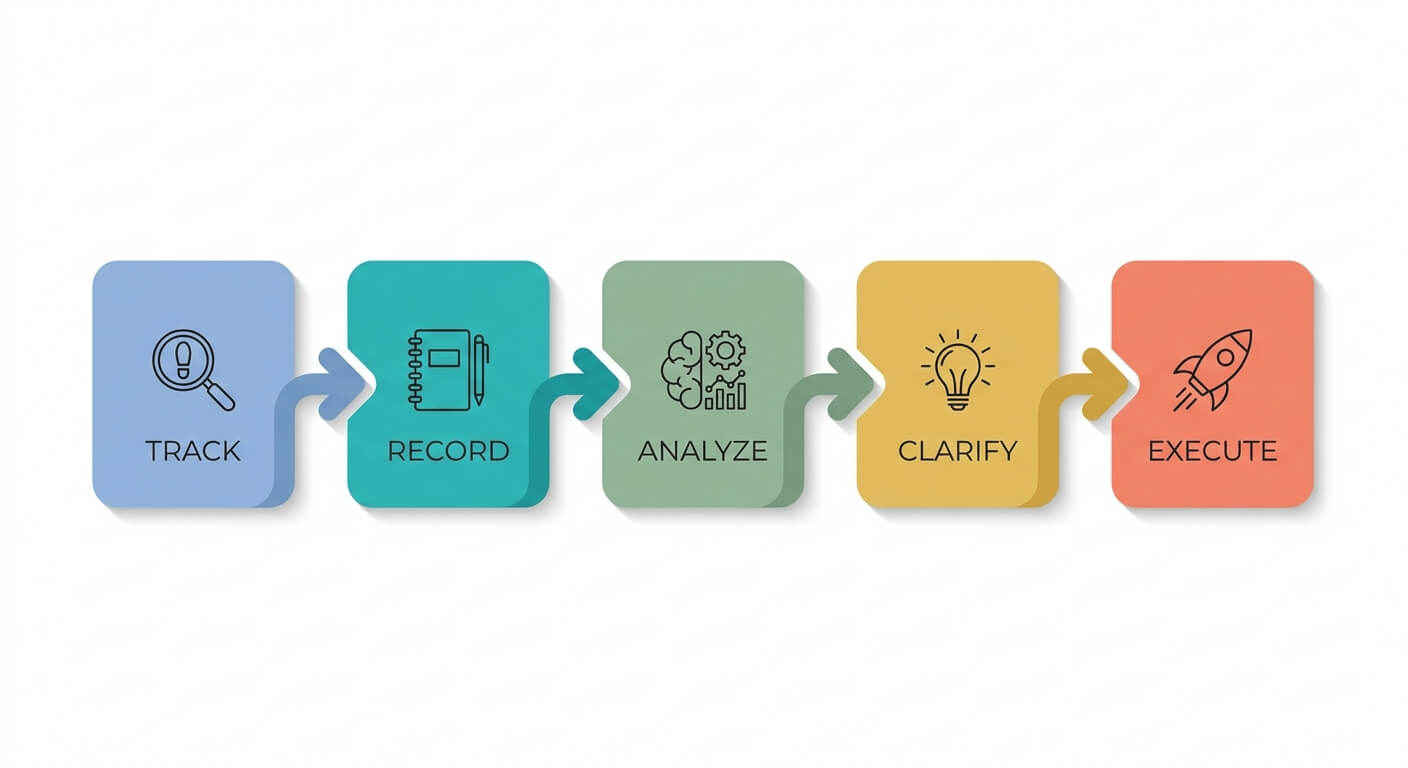
The process starts with a full inventory: every subscription, every platform login, every tool your team uses regularly, including the smaller ones someone signed up for to solve a single problem and never mentioned again. Against that inventory, the audit doesn’t just record cost. It records time. How long does each task take? How many systems must staff access to complete common workflows? Where do manual handoffs occur?
But the audit is understanding your current reality, not your intended processes. Most firms have official workflows documented somewhere, but daily operations tell a different story. People develop workarounds, create shadow processes, and build personal systems to cope with gaps in the official technology stack.
During a recent audit, I discovered that a consulting firm’s project managers were maintaining elaborate spreadsheets that duplicated information from four different systems. They’d created these personal databases because no single system gave them the complete picture they needed to manage their projects effectively.
The audit reveals these shadow processes and quantifies their impact. How many hours per week does each team member spend on manual data handling? How often do client requests get delayed because information exists in the wrong system? How many billable hours go unrecorded because the time tracking system doesn’t integrate with project management? Usage analytics on your existing platforms often turn up a further surprise: premium features nobody uses, or subscriptions to tools nobody has opened in months. Software vendors make it easy to upgrade and difficult to downgrade for good reason, and few firms notice until an audit forces the question.
I analyse every touchpoint where information moves between systems or people. Each manual step represents a potential failure point and a drain on productivity. The goal isn’t to eliminate all manual processes, but to ensure that human time is spent on activities that genuinely require human judgment and expertise.
System redundancy emerges as another common issue. Firms often subscribe to multiple tools that perform similar functions, usually because different teams chose solutions independently. An audit identifies these overlaps and evaluates whether consolidation makes sense. Identifying and eliminating this redundancy is one of the most immediate financial wins a tech stack audit can deliver.
Security gaps become apparent when you map how data moves through disconnected systems. Information stored in multiple places, with different access controls and backup procedures, creates compliance risks that many firms don’t fully appreciate until they’re examined systematically.
The audit also assesses how well your current technology stack supports your business model and growth plans. A system that worked perfectly for a ten-person firm might create bottlenecks at twenty people. Tools chosen for immediate needs might not scale gracefully as client requirements become more sophisticated.
Common Integration Challenges in Professional Services
Professional services firms face unique integration challenges that standard business software often handles poorly. The project-based nature of most professional work doesn’t map neatly onto systems designed for predictable, repeating processes.
Client data presents one of the most complex integration challenges. A single client relationship might span multiple projects, involve different service lines, and require various access permissions. Information about that client gets scattered across project management tools, billing systems, document repositories, and communication platforms. When a team member needs to understand the complete client relationship, they embark on a digital scavenger hunt. Project details live in one system, billing history in another, and recent communications in a third. This fragmentation doesn’t just waste time; it degrades the quality of client service when important context gets overlooked.
Billing and time tracking integration challenges plague most professional services firms. Time gets recorded in project management systems, but billing happens elsewhere. The translation between recorded time and invoiceable services often requires manual intervention, creating delays and introducing errors. Complex billing arrangements compound the problem. When clients have different rate structures for different types of work, or when projects involve multiple service lines with separate billing, the lack of system integration creates administrative nightmares. What should be automatic calculations become manual spreadsheet exercises performed under deadline pressure.
Document management represents another persistent integration challenge. Project files get scattered across email attachments, cloud storage folders, and specialised document management systems. Version control becomes nearly impossible when team members can’t easily determine which system contains the authoritative copy of important documents.
Knowledge management suffers in fragmented environments too. The insights and methodologies developed during client engagements get trapped in individual systems or personal files. Future projects can’t benefit from past learnings because there’s no effective way to capture, organise, and retrieve institutional knowledge. Reporting compounds the problem: creating comprehensive project reports or client dashboards requires manual data gathering from various sources, often resulting in reports that are outdated by the time they’re completed.
Regulatory compliance adds another layer of complexity. Professional services firms often operate under strict confidentiality and data protection requirements. When client information exists in multiple systems with different security protocols, maintaining compliance becomes significantly more challenging and expensive.
Building an Integrated Technology Foundation
Creating an integrated technology foundation for professional services requires a different approach from standard business automation. The solution needs to accommodate the fluid, project-based nature of professional work while maintaining the structure necessary for efficient operations.
The foundation starts with establishing clear data ownership and flow principles. Every piece of information should have a definitive source, and other systems should access that information through integration rather than maintaining separate copies. This eliminates the synchronisation problems that plague most fragmented environments, where a customer updates their address in the CRM and someone must remember to carry that change into billing, shipping and marketing separately.
Client relationship management becomes the central hub around which other systems revolve. When client information, project history, and communication records exist in a single, accessible location, every team member can provide informed service regardless of which specific projects they’ve worked on previously.
Project management integration extends beyond simple task tracking. An integrated approach connects project planning with resource allocation, time tracking with billing, and project outcomes with knowledge management. This creates a seamless flow from initial client engagement through project delivery and ongoing relationship management.
Financial integration addresses one of the most painful aspects of professional services administration. When time tracking, expense recording, and billing operate as connected processes rather than separate activities, the administrative burden drops dramatically while accuracy improves.
Document and knowledge management integration ensures that project insights and methodologies become institutional assets rather than individual knowledge. This supports both quality consistency and business development, as past project experiences can inform future proposals and delivery approaches.
Communication integration prevents important client interactions from getting lost in individual email inboxes or instant messaging threads. When client communications connect automatically to project records and client histories, nothing falls through the cracks.
Reporting and analytics capabilities emerge naturally from well-integrated systems. When all project and client information exists in connected systems, creating comprehensive reports becomes automatic rather than manual. This enables better decision-making and more proactive client service.
Security and compliance integration ensures that data protection measures work consistently across all systems. Rather than managing separate security protocols for each tool, an integrated approach provides comprehensive protection through coordinated policies and procedures.
The system integration process requires careful planning and phased implementation. Attempting to replace multiple systems simultaneously often creates more disruption than benefit. A systematic approach identifies the most critical integration points and addresses them in order of impact and complexity, starting with the manual processes that create the most daily friction rather than trying to connect everything at once.
Measuring the Impact of System Unification
Successful system unification delivers measurable improvements across multiple dimensions of professional services operations. These improvements often exceed initial expectations because the benefits compound as integrated processes become embedded in daily operations.
Time recovery represents the most immediate and visible benefit. When professionals no longer need to manually transfer information between systems or hunt for data across multiple platforms, they reclaim substantial amounts of productive time. This time can return to billable client work or business development activities. The maths behind this is usually more compelling than firms expect. If three staff members spend just 30 minutes a day on manual data entry that automation could eliminate, at an average hourly rate of $30, that’s $100 a day, or roughly $32,000 a year, spent on work that adds no value for the client.
Error reduction provides another significant benefit. Manual data transfer inevitably introduces errors, from simple transcription mistakes to more serious issues like billing the wrong client or missing project deadlines due to calendar synchronisation failures. Integrated systems eliminate most of these error sources.
Client service quality improves when team members have complete, up-to-date information readily available. Clients notice when their service providers remember previous conversations, understand their complete project history, and can respond quickly to requests without extensive background research.
Billing accuracy and speed typically improve dramatically after system unification. When time tracking automatically flows into billing systems with appropriate rate structures and client-specific arrangements already configured, invoices become faster to generate and more accurate. These improvements directly impact cash flow while reducing administrative overhead for both the firm and its clients.
Reporting capabilities transform from time-consuming manual exercises into automatic processes that provide real-time insights. Project profitability, resource utilisation, and client satisfaction metrics become readily available rather than requiring special analysis projects. Compliance management becomes more reliable too, as audit trails become automatic rather than requiring manual reconstruction from multiple sources.
Team satisfaction often improves significantly as professionals spend more time on meaningful work and less on administrative tasks. This can impact both retention and recruitment, as skilled professionals prefer environments where technology supports rather than hinders their work. Business development benefits as well, from better institutional knowledge capture and accessibility: when past project experiences and client insights are systematically captured and easily retrievable, proposal development and new client conversations become more informed and effective.
Effective measurement focuses on the problems the firm set out to solve, not generic efficiency metrics. If manual data entry was consuming too much time, track time spent on data entry tasks. If client service was slowed by system switching, measure average response times. Faster task completion only matters if it enables better client service, more work won, or reduced labour costs, so tie every metric back to a business result rather than an activity level.
Implementation Strategy and Phases
Implementing system unification for professional services requires a carefully planned approach that minimises disruption while delivering tangible benefits at each stage. The most successful implementations focus on solving specific pain points rather than attempting comprehensive transformation immediately.
Phase one typically addresses the most critical integration gaps, usually involving client data and project information. Establishing a single source of truth for client relationships and project status provides immediate benefits while creating the foundation for additional integrations.
The process optimisation phase examines current workflows and identifies opportunities for streamlining before adding technology complexity. Often, business processes can be simplified or improved independent of technology changes, making subsequent system integration more effective. Prioritise by impact and difficulty: quick wins that eliminate daily friction points build momentum for larger projects, while complex migrations that touch critical business processes need more careful planning and longer timelines.
Data migration and cleaning represent critical early activities that determine long-term success. Professional services firms often have years of valuable information trapped in various systems, but that information requires careful cleaning and standardisation before it can be effectively integrated. Plan migration during slower business periods and maintain parallel systems until you’re confident everything works correctly.
Training and change management deserve as much attention as technical implementation. Even perfectly integrated systems provide little benefit if team members continue using old processes or don’t understand new capabilities. Effective training focuses on demonstrating immediate personal benefits rather than abstract system features, and it needs dedicated time: expect a temporary productivity dip while people adjust to new workflows.
Testing and validation phases ensure that integrated systems work correctly under real operating conditions. Professional services work often involves complex scenarios that don’t emerge during standard system testing, so thorough validation with actual client projects becomes essential.
Monitoring and optimisation continue after initial implementation. System integration creates opportunities for further improvements that only become apparent once people begin using new capabilities in their daily work. Track the metrics used to justify the changes, and be prepared to adjust workflows based on real-world usage; what looks efficient on paper can still reveal unexpected friction points in daily use.
The implementation strategy must account for client service continuity. Professional services firms cannot afford disruptions that affect client deliverables or communication. Successful implementations often run parallel systems temporarily to ensure seamless transitions. Security and compliance considerations influence every implementation decision throughout, since firms handling confidential client information must ensure that system changes enhance rather than compromise data protection capabilities.
Choosing the Right Integration Approach
Professional services firms have several options for achieving system integration, each with distinct advantages and considerations. The optimal approach depends on current technology investments, business requirements, budget constraints, and growth plans.
Native integrations between existing systems often provide the quickest path to improved connectivity. Many professional services tools offer built-in connections to complementary platforms, allowing information sharing without major system changes. However, native integrations typically address only basic data sharing and may not support complex business processes.
No-code integration platforms such as Zapier and n8n create connections between systems that weren’t designed to work together, using visual, drag-and-drop workflow builders rather than custom code. They offer pre-built connections to thousands of popular business applications, letting a workflow trigger automatically when something happens in one system and update another without a developer involved. This kind of middleware can be particularly effective for firms with significant investments in specialised tools that provide unique value, and increasingly these platforms add AI to the connection itself, so a workflow can make a decision based on data patterns and business rules rather than a simple if-then rule.
Unified platform approaches replace multiple disconnected systems with comprehensive solutions designed for professional services. While this requires more extensive change management, unified platforms often provide the most seamless user experience and eliminate many integration challenges entirely.
Custom integration development creates precisely tailored connections between systems but requires ongoing technical support and maintenance. This approach makes sense for firms with unique requirements that standard solutions cannot accommodate effectively. Cloud-based integration platforms provide middle-ground solutions that combine the flexibility of custom development with the support and maintenance of commercial platforms, and often prove cost-effective for growing firms that need sophisticated integration capabilities without extensive technical teams.
The strategic consulting process helps firms evaluate these options based on their specific requirements and constraints. Factors include current system investments, technical team capabilities, budget considerations, timeline requirements, and growth projections.
Vendor selection for integration solutions requires careful evaluation of professional services experience and support capabilities. Solutions designed for other industries may not accommodate the project-based, client-centric nature of professional services work effectively. Implementation complexity varies significantly between approaches: native integrations typically require minimal technical expertise but may provide limited functionality, custom development offers maximum flexibility but demands ongoing technical resources, and unified platforms fall somewhere between these extremes.
Long-term maintenance and support considerations influence the total cost of ownership for different integration approaches. Some solutions require minimal ongoing attention, while others need constant monitoring and adjustment to maintain effectiveness. Scalability assessment ensures that integration choices support business growth rather than creating future constraints, since solutions that work effectively for current operations may not accommodate expanded teams, additional service lines, or more complex client requirements.
Maximising Long-term Value
Successful system unification provides the foundation for ongoing operational improvements and business growth. The initial integration project creates capabilities that continue delivering value as firms develop more sophisticated ways to use connected systems.
Data analytics capabilities emerge naturally from well-integrated systems. When project, client, and financial information exists in connected formats, sophisticated analysis becomes possible without extensive manual data preparation. These insights can inform strategic decisions about service offerings, pricing, resource allocation, and business development priorities.
Automation opportunities multiply in integrated environments. Routine tasks like status reporting, billing preparation, and project documentation can become largely automatic when systems share information seamlessly. This frees professional time for higher-value activities while improving consistency and accuracy. Client service enhancement continues evolving as teams discover new ways to use integrated information: complete client histories enable more personalised service, while project insights can inform recommendations for additional services or process improvements.
Knowledge management systems become more valuable when connected to project and client information. Methodologies, templates, and best practices can be automatically associated with relevant contexts, making institutional knowledge more accessible and actionable. Business development activities benefit in turn from integrated information about client relationships, project outcomes, and market opportunities, so proposal development becomes more informed and efficient when past project data and client insights are readily accessible.
The AI automation capabilities that integrated systems enable can transform routine operations while maintaining the personal touch that professional services require. Intelligent systems can handle scheduling, basic client communications, and routine analysis while flagging situations that require human attention.
Compliance and risk management become more robust when integrated systems provide complete audit trails and consistent data protection measures, reducing regulatory risk while simplifying reporting and internal controls. Scaling operations also becomes significantly easier when systems support growth rather than constraining it: adding new team members, expanding service offerings, or entering new markets requires less system disruption when technology infrastructure can accommodate change seamlessly.
Technology needs evolve as businesses grow and change. What works for a ten-person firm creates bottlenecks at twenty. Systems that handle a modest caseload might struggle once volume grows. Regular review, not a one-off project, prevents small inefficiencies from becoming major problems, and understanding your vendors’ product roadmaps helps you avoid platforms that won’t meet future needs. The competitive advantage that integrated systems provide often increases over time as competitors struggle with fragmented operations. Firms with unified technology stacks can respond more quickly to client needs, provide more accurate project estimates, and deliver more consistent service quality.
Tech stack audits reveal the hidden costs and missed opportunities that fragmented systems create in professional services firms. The path to unified operations requires systematic analysis, careful planning, and thoughtful implementation, but the results justify the effort. When systems work together seamlessly, professionals can focus on what they do best: solving complex problems and building lasting client relationships.
Frequently Asked Questions
What is a tech stack audit and why do professional services firms need one?
A tech stack audit systematically examines all software systems your firm uses, how they connect (or don’t), and where inefficiencies exist. Professional services firms need audits because disconnected systems waste productive time on manual data entry, create billing errors, and prevent professionals from accessing complete client information when they need it most.
How long does it take to complete a comprehensive tech stack audit?
A thorough tech stack audit typically takes 2-4 weeks depending on firm size and system complexity. This includes cataloguing all software, mapping information flows, interviewing team members about actual workflows, identifying shadow processes, and quantifying costs. Rushing the audit risks missing critical integration issues that will resurface later during implementation.
How often should a firm repeat a tech stack audit?
A comprehensive audit is worth repeating annually, with a lighter quarterly review of any new software added and how it’s actually being used. Rapid growth or a significant change in the business, such as a new service line or a jump in headcount, calls for a check sooner rather than waiting for the calendar to catch up.
What’s the average return on investment for system integration projects?
Most professional services firms reclaim 15-20% of productive time previously lost to manual data handling and system switching. This translates to significant revenue gains when those hours return to billable work. Simple integrations often pay for themselves within 3-4 months, while billing accuracy improvements, reduced errors, and enhanced client service create compounding benefits that often exceed initial projections within 12-18 months for larger consolidation projects.
Can systems be integrated gradually or must everything change at once?
Phased implementation is strongly recommended for professional services firms. Start by integrating the most painful disconnection points, typically client data and project information, then expand to billing, document management, and reporting. This approach delivers immediate benefits whilst minimising disruption to client service, allowing teams to adapt gradually to new workflows.
How do you maintain system integration when business requirements change?
Choose integration approaches that support flexibility and growth. Cloud-based platforms and middleware solutions typically adapt more easily than hard-coded custom integrations. Regular quarterly reviews of system performance and emerging requirements help identify necessary adjustments before they become urgent problems. Well-integrated systems actually accommodate change more gracefully than fragmented ones.