AI Chatbots Boost Retail Customer Response Around the Clock
Discover how AI chatbots provide instant customer responses 24/7, boosting retail sales and freeing staff for complex enquiries. Real ROI for small retailers.
Contents
Every customer message that goes unanswered after hours is a sale walking to a competitor who replies first. AI chatbots close that gap without adding headcount, answering routine questions the moment they arrive, day or night. AI chatbots for small retailers start from $250 to $500 a month, with initial setup from $1,900.
This pattern repeats across the retail businesses I work with. A customer visits your website at 9pm on Sunday. They have a simple question about sizing, availability, or delivery. Your phone goes unanswered. Your contact form sits empty until Monday morning. By then, they’ve bought elsewhere.
AI chatbots solve this fundamental problem. They provide instant responses when customers need them most, without requiring you to be available every hour of every day. Businesses implementing AI customer service solutions now handle routine enquiries automatically, freeing staff to focus on complex customer needs and in-store service.
The Real Cost of Missed Customer Contact
Every unanswered question represents lost revenue. Customers researching purchases outside business hours aren’t window shopping; they’re ready to buy. When they can’t get immediate answers, they move to competitors who can provide them.
Consider the typical customer journey. Someone discovers your product through social media or search. They visit your website with specific questions: Does this come in blue? Can you deliver by Friday? What’s your return policy? Without immediate answers, they abandon the purchase.
Traditional solutions don’t work for small retailers. Hiring staff for 24-hour coverage costs more than most small businesses generate in profit. Outsourcing customer service means losing control over quality and brand experience. Meanwhile, your competitors with better automation capture sales you should be winning.
Businesses can lose potential online revenue due to inadequate after-hours customer support. The solution isn’t working longer hours; it’s working smarter through AI automation strategy that handles routine enquiries automatically.
How AI Chatbots Transform Customer Response
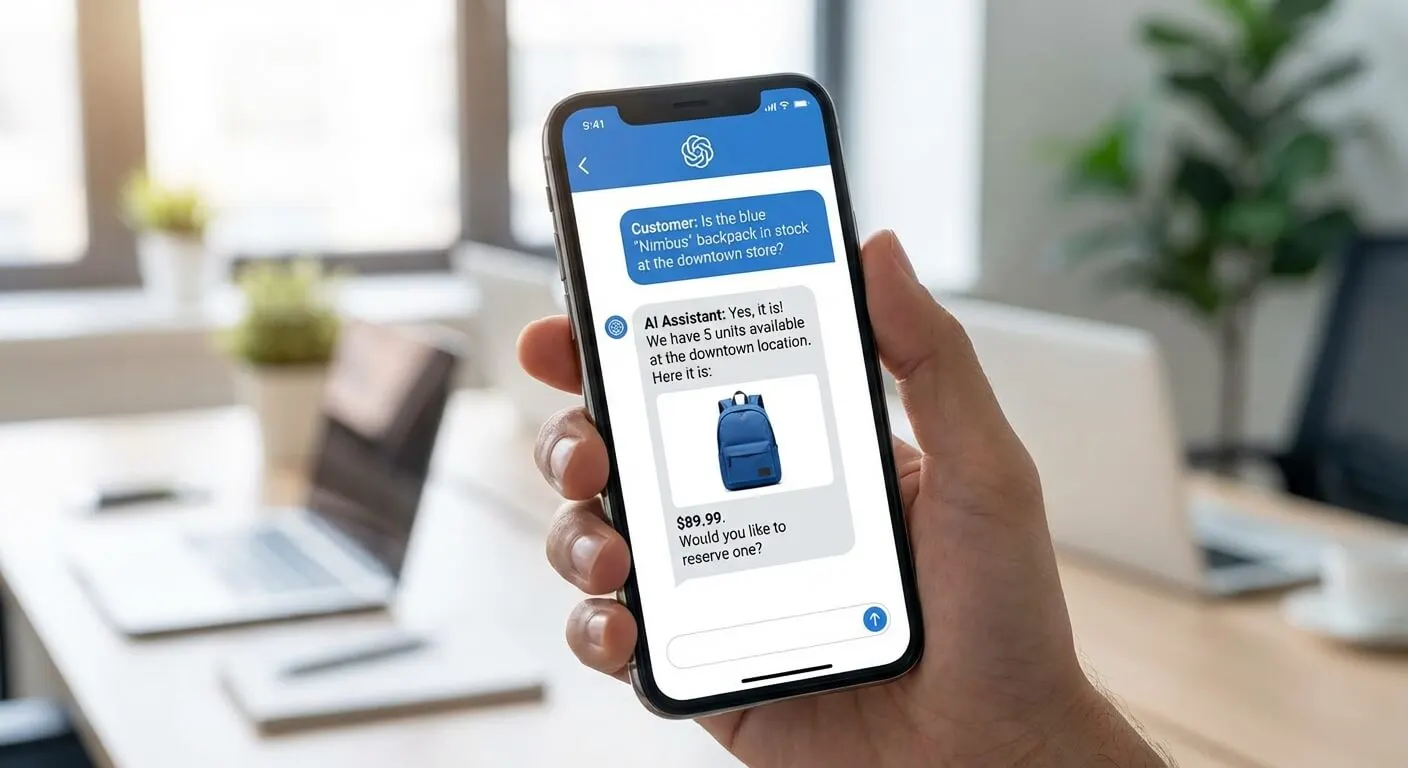
Modern AI chatbots understand context, not just keywords. When a customer asks “Do you have this in large?”, the system recognises they’re viewing a specific product and provides accurate stock information. When someone asks about delivery times, it checks their location and provides realistic timeframes.
The technology integrates seamlessly with existing systems. Your chatbot connects to inventory management, knowing exactly what’s in stock. It links to your order system, tracking delivery status in real-time. It accesses your product catalogue, providing detailed specifications without human intervention.
Implementation typically takes 2-3 weeks. The system learns from your existing customer enquiries, understanding the questions people actually ask. It studies your product information, learning how to describe features and benefits in your brand voice. Most importantly, it knows when to escalate complex issues to human staff.
Customers appreciate instant responses. They can research purchases at their convenience, getting immediate answers to straightforward questions. For complex issues requiring human expertise, the chatbot schedules callbacks or escalates to available staff, ensuring nothing falls through gaps.
Common Customer Questions AI Handles Perfectly
Certain enquiries repeat constantly in retail. Stock availability, sizing information, delivery options, return policies, opening hours, location details. These questions have factual answers that don’t require human judgement or creativity.
AI excels at providing consistent, accurate responses to factual enquiries. A customer asking “What sizes do you stock in men’s shirts?” receives the same comprehensive answer at 2am Sunday as they would from your best salesperson on Wednesday afternoon. The information never varies due to staff mood, knowledge gaps, or miscommunication.
Product recommendations represent another strength. When someone describes what they need, AI can suggest appropriate options based on your inventory and their requirements. “I need waterproof boots for hiking” generates relevant product suggestions with key features highlighted.
Order tracking becomes effortless. Customers input order numbers and receive current status, estimated delivery dates, and tracking information instantly. No waiting for office hours, no telephone queues, no email delays.
Technical specifications and compatibility questions get handled efficiently. “Will this phone case fit an iPhone 13 Pro?” receives a definitive yes or no answer, often with additional relevant information about colour options or delivery timeframes.
Integration with Your Current Systems
Effective chatbot implementation requires seamless integration with existing business systems. Your AI assistant needs access to real inventory data, not last week’s stock list. It must connect to your order management system, providing accurate delivery information. Without proper integration, chatbots become glorified FAQ pages that frustrate rather than help customers.
Most retail businesses use multiple systems: inventory management, point-of-sale, accounting, website platform, email marketing. AI chatbots need to communicate across these systems, presenting unified information to customers while updating records automatically.
System integration ensures your chatbot accesses live data from all relevant sources. When inventory changes, the chatbot knows immediately. When orders ship, customers receive instant updates. When new products launch, the assistant can discuss features and availability without delay.
The integration process varies depending on your current technology stack. Cloud-based retail systems typically offer API connections that enable smooth data flow. Legacy systems might require additional middleware to bridge old and new technologies. The goal remains consistent: provide customers with accurate, current information regardless of when they enquire.
Security considerations matter enormously. Customer data must remain protected throughout the integration process. Payment information needs proper encryption. Personal details require appropriate access controls. Working with experienced integration specialists ensures compliance with data protection requirements while maintaining system performance.
Training AI to Match Your Brand Voice
Generic chatbot responses destroy brand experience. Customers notice when automated responses feel impersonal or inconsistent with your usual communication style. Training AI to match your brand voice requires careful attention to tone, language, and personality.
Start with your existing customer communications. Email responses, social media posts, product descriptions, and staff training materials all contain examples of your brand voice. AI systems learn from these examples, understanding how you typically communicate with customers.
Consider your target audience carefully. A luxury boutique requires different language than a discount electronics store. Technical products need more detailed explanations than fashion items. Age demographics influence communication style significantly; younger customers often prefer casual, direct responses while older customers might expect more formal interactions.
Testing proves essential during voice training. Run sample conversations with the AI, checking responses for tone, accuracy, and helpfulness. Involve staff members who regularly handle customer enquiries; they understand subtle communication preferences that might not appear in written guidelines.
Continuous refinement improves results over time. Monitor actual customer conversations, identifying responses that work well and areas needing improvement. Customer feedback provides valuable insights into communication effectiveness. The goal isn’t perfect responses from day one, but steady improvement towards excellent customer experience.
Measuring Success and ROI
Implementing AI chatbots requires investment, and business owners need clear evidence of returns. Measuring success involves tracking multiple metrics beyond simple conversation counts.
Response time improvement provides the most obvious metric. Before automation, customers might wait hours or days for email responses. With AI chatbots, response times drop to seconds for routine enquiries. This improvement directly impacts customer satisfaction and conversion rates.
Sales attribution becomes possible through proper tracking. When chatbots help customers find products and complete purchases, the system records these interactions. You can measure how many sales result directly from chatbot assistance, calculating precise revenue impact.
Staff time savings translate to real cost benefits. Calculate hours previously spent answering routine questions, multiply by staff hourly costs, and compare against chatbot operating expenses. The arithmetic usually favours automation significantly, especially for businesses handling high enquiry volumes.
Customer satisfaction scores often improve with 24-hour availability. Surveys can measure whether customers appreciate instant responses and find chatbot assistance helpful. Net Promoter Scores frequently increase when customers can get quick answers to simple questions.
Operational efficiency gains extend beyond direct customer interaction. Staff can focus on complex customer needs, in-store service, and business development activities instead of repeating basic information dozens of times daily.
Advanced Features for Growing Businesses
Basic question-and-answer functionality represents just the beginning of chatbot capabilities. Advanced features can transform customer relationships and business operations significantly.
Personalisation improves customer experience dramatically. When returning customers interact with your chatbot, it can recognise their previous purchases, preferences, and enquiry history. This enables tailored product recommendations and more efficient problem-solving.
Multilingual support expands market reach for businesses serving diverse communities. AI can detect customer language preferences and respond appropriately, removing barriers that might prevent sales to non-English speakers.
Appointment scheduling integrates particularly well with service-based retailers. Customers can book consultations, fittings, or collection appointments directly through chat interface, with confirmations sent automatically to both customer and business calendars.
Inventory alerts create proactive customer service opportunities. When popular items come back into stock, the chatbot can notify customers who previously enquired about availability. This feature often generates immediate sales from customers who had given up waiting.
Order modification capabilities reduce administrative burden. Customers can update delivery addresses, change product specifications, or modify quantities through the chatbot interface, with changes automatically updating in your order management system.
Implementation Strategy for Small Retailers

Successful chatbot implementation follows a structured approach. Rushing into advanced features without solid foundations often leads to customer frustration and wasted investment.
Begin with comprehensive enquiry analysis. Review three months of customer emails, phone calls, and in-person questions. Identify the 20 most common enquiries; these become your chatbot’s initial focus. Starting with frequently asked questions ensures immediate impact and builds confidence in the system.
Prepare your data thoroughly before launch. Ensure product information is complete and current. Verify stock levels are accurate across all systems. Update delivery information, return policies, and contact details. Chatbots can only provide answers based on the information they receive.
Choose implementation partners carefully. AI automation strategy requires technical expertise combined with retail industry understanding. Look for providers who understand small business constraints and can deliver solutions within realistic budgets and timeframes.
Plan for gradual rollout rather than immediate full deployment. Start with basic enquiries during off-hours, when mistakes cause less disruption. Monitor performance closely, adjusting responses based on actual customer interactions. Expand functionality once core features work reliably.
Train staff to work alongside AI systems effectively. They need to understand when chatbots escalate enquiries and how to access conversation history. Staff should also know how to override or supplement chatbot responses when necessary, maintaining seamless customer experience.
Avoiding Common Implementation Mistakes
Many small retailers make predictable errors when implementing chatbot technology. Learning from others’ mistakes prevents wasted time and money while ensuring better customer outcomes.
Overcomplicating initial functionality represents the most common mistake. Business owners often want chatbots to handle every possible enquiry from launch day. This approach usually produces mediocre results across all functions rather than excellent performance on essential tasks. Focus on core enquiries first, expanding gradually.
Neglecting mobile optimisation causes significant problems. Most customers interact with chatbots through mobile devices, yet many implementations work poorly on smaller screens. Test extensively on various devices and screen sizes before launch.
Ignoring conversation flow design leads to frustrating customer experiences. Customers should reach relevant information quickly without navigating complex menu systems. Design conversations as you would real-life interactions: natural, efficient, and goal-oriented.
Failing to plan escalation procedures creates customer service gaps. Chatbots cannot handle every enquiry, and customers need clear paths to human assistance when required. Define escalation triggers clearly and ensure staff can access conversation history when taking over.
Underestimating ongoing maintenance requirements surprises many business owners. Product catalogues change, policies update, seasonal information shifts. Chatbots need regular updates to maintain accuracy and relevance. Budget for ongoing maintenance from the beginning.
Future-Proofing Your Customer Service Investment
Technology evolves rapidly, and chatbot capabilities continue expanding. Smart implementation considers future developments while delivering immediate value.
Choose platforms that support integration with emerging technologies. Voice recognition, visual search, and augmented reality features are becoming standard in retail technology. Your chatbot platform should accommodate these developments without requiring complete reimplementation.
Prioritise data collection and analysis capabilities. Customer interaction data becomes increasingly valuable for understanding preferences, identifying trends, and optimising operations. Ensure your chatbot system captures meaningful analytics that can guide business decisions.
Consider scalability requirements carefully. Solutions that work for 100 daily enquiries might struggle with 1,000. Choose platforms that can grow with your business without requiring expensive migrations or complete rebuilds.
Stay informed about regulatory developments affecting AI and customer data. Privacy laws continue evolving, and compliance requirements change regularly. Work with strategic consulting partners who monitor regulatory changes and can guide necessary adjustments.
Plan for integration with broader business automation initiatives. Customer service chatbots often become entry points for comprehensive process optimisation projects that transform entire business operations.
Making the Investment Decision
Chatbot implementation requires upfront investment, and small business owners need clear justification for spending. The calculation extends beyond simple cost comparisons to encompass opportunity costs and competitive positioning.
Calculate current customer service costs accurately. Include staff time spent answering routine enquiries, lost sales from missed after-hours contacts, and customer acquisition costs for replacing frustrated prospects. These figures often exceed expectations significantly.
Consider competitive pressure realistically. Customers increasingly expect immediate responses and 24-hour availability. Businesses without automated customer service appear outdated compared to competitors who provide instant assistance.
Evaluate growth implications carefully. Manual customer service becomes exponentially more expensive as enquiry volumes increase. Automated systems scale efficiently, handling increased volumes without proportional cost increases.
Factor in staff satisfaction improvements. Employees prefer helping customers with complex, interesting problems rather than repeating basic information constantly. Chatbots eliminate routine enquiries, enabling staff to focus on valuable activities that improve job satisfaction and reduce turnover.
The investment often pays for itself within months through improved conversion rates and reduced staff time requirements. More importantly, it positions your business for sustainable growth without proportional increases in customer service overhead.
AI chatbots aren’t about replacing human customer service; they’re about making it more effective. When routine enquiries get handled automatically, your staff can focus on building relationships, solving complex problems, and creating experiences that drive customer loyalty. That’s the kind of customer service that builds lasting businesses.
Frequently Asked Questions
How long does it take to implement an AI chatbot for my retail business?
Typical implementation takes 2-3 weeks from initial setup to launch. This includes integrating the chatbot with your existing systems, training it on your product catalogue and common enquiries, and testing conversation flows. More complex implementations with extensive product ranges or multiple system integrations may take 4-6 weeks. The key is starting with core functionality rather than trying to handle every possible enquiry from day one, then expanding capabilities based on actual customer interactions.
Can AI chatbots really understand regional dialects and informal language?
Modern AI chatbots use natural language processing that recognises context, intent, and variations in phrasing. They understand that “Have you got this in stock?” and “Do you have any left?” mean the same thing. They can handle informal language, abbreviations, and common misspellings. However, they work best when trained on your actual customer enquiries, learning the specific language your customers use. The system improves continuously as it processes more conversations, becoming better at understanding regional variations and informal expressions over time.
What happens when a customer asks something the chatbot can’t answer?
Well-designed chatbots recognise their limitations and escalate appropriately. When facing questions outside their knowledge base or detecting customer frustration, they immediately offer to connect customers with human staff. The escalation can take several forms: scheduling a callback during business hours, sending an alert to available staff for immediate assistance, or capturing detailed information for follow-up. Crucially, the chatbot preserves the entire conversation history, so staff can see exactly what was discussed without making customers repeat themselves.
How much does AI chatbot implementation cost for a small retail business?
Implementation costs vary based on business size, system complexity, and required features. Basic chatbot solutions for small retailers typically start from $250-500 monthly, including hosting, maintenance, and standard integrations. Initial setup costs range from $1,900-5,000 depending on customisation requirements and system integrations. The key is choosing solutions that scale with your business, starting with essential features and expanding as you grow.
Will customers prefer chatbots over speaking to real people?
Research shows customers value speed and convenience over interaction method. However, they expect seamless escalation to human staff for complex issues. The ideal approach combines automated responses for routine questions with easy access to knowledgeable staff for situations requiring human judgement, empathy, or creative problem-solving. Most customers appreciate chatbots that save them time whilst maintaining the option to speak with people when needed.