Building the Business Case: When AI ROI Actually Pays Off for SMBs
Calculate realistic AI ROI for your small business. Learn when automation actually pays off, avoid common pitfalls, and build compelling business cases that work.
Contents
Most AI return-on-investment conversations go nowhere, not because the technology fails, but because people start with the technology and look for a problem to fit it, instead of starting with a genuine cost and calculating what solving it is worth. As a rough guide, Marathon prices these builds as fixed projects, from US$450 for a single workflow to US$16,000 for a custom application, so the real question is whether your inefficiency costs more than that over a year.
The reality is simpler than the hype suggests. AI pays off when it addresses specific, measurable inefficiencies that are already costing you time or money. Everything else is noise.
Understanding Real AI Costs
The first mistake most small businesses make is underestimating the true cost of implementing AI solutions. The software licence fee is just the beginning.
You’ll need time to learn the system, possibly training for your team, and almost certainly some data cleaning before anything works properly. That customer database you’ve been meaning to organise? The one with duplicate entries and phone numbers in three different formats? That needs sorting before any AI tool can make sense of it.
This isn’t a criticism of AI tools, it’s just reality. Every new system requires investment before it delivers returns.
I’ve seen businesses spend weeks configuring a customer relationship management system, only to abandon it because they didn’t budget for the setup time. The software worked perfectly, but they ran out of patience before they saw results.
The hidden costs extend beyond initial setup. Most AI tools require ongoing data maintenance, regular software updates, and periodic optimisation to maintain effectiveness. Factor these into your calculations from the start, not as unwelcome surprises six months later.
Calculating Your Current Inefficiency Costs
Before evaluating any AI solution, you need to understand what your current processes actually cost. This means tracking time spent on repetitive tasks, measuring error rates, and calculating the real cost of delays.
Take invoice processing as a common example. If someone spends two hours weekly chasing unpaid invoices, calling customers, updating spreadsheets, and sending reminder emails, that’s 104 hours annually. At $30 per hour, you’re spending $3,200 yearly on this single process.
But the true cost runs deeper. While your team member chases invoices, they’re not doing other valuable work. Late payments affect your cash flow, potentially costing you early payment discounts or forcing you to delay your own payments. Customer relationships might suffer from inconsistent follow-up timing.
Manual data entry provides another clear example. Beyond the obvious time cost, consider the error rate. If mistakes require corrections, customer service calls, or duplicate work, factor these expenses into your calculations. A 5% error rate on order processing might seem acceptable until you calculate the cost of fixing those mistakes.
For a business with $250,000 annual revenue, that’s potentially $52,000 worth of time that could be redirected to revenue-generating activities.
Document where your team spends time on repetitive tasks. Note how often mistakes occur and what fixing them costs. Measure how delays in one process affect others. This baseline becomes your comparison point for evaluating AI solutions.
High-ROI AI Applications for Small Businesses
Not all AI applications deliver equal returns. The highest ROI typically comes from automating high-frequency, low-complexity tasks that currently consume significant human time.
Customer service automation often provides immediate returns. Chatbots handling common enquiries, automatic email responses to frequent questions, and intelligent routing of support tickets can reduce response times while freeing up human agents for complex issues. The technology has matured enough that implementation doesn’t require extensive technical expertise.
Inventory management represents another high-return area. AI can analyse sales patterns, predict demand fluctuations, and automatically reorder stock based on historical data and seasonal trends. For product-based businesses, this eliminates the guesswork that leads to stockouts or excess inventory.
Marketing automation delivers measurable returns when properly implemented. Automatically segmenting customers based on behaviour, sending personalised email sequences, and scoring leads based on engagement patterns can dramatically improve conversion rates while reducing manual marketing effort.
Financial processes offer clear ROI opportunities. Automated expense categorisation, invoice processing, and basic financial reporting eliminate hours of manual bookkeeping while improving accuracy. The time savings are immediate and quantifiable.
Scheduling and appointment management automation prevents the back-and-forth emails that eat up administrative time. Clients book directly into available slots, receive automatic confirmations and reminders, and can reschedule without human intervention.
The key is selecting applications where the current manual process is well-defined and time-consuming. Avoid trying to automate complex decision-making processes or tasks that require significant human judgement. Start with the boring, repetitive work that nobody enjoys doing anyway.
What this costs varies with scope, not with how impressive the result looks. Marathon prices these as fixed projects, so you know the number before you commit:
| Scope | Example from above | Fixed project cost |
|---|---|---|
| Single workflow joining two systems | Scheduling tool synced to your calendar | From US$450 |
| Multi-step workflow with integrations | Lead scoring across CRM and email | From US$1,400 |
| Document or invoice processing pipeline | Automated expense categorisation and invoicing | From US$2,375 |
| Custom application built around a process | Inventory demand prediction and reordering | From US$7,250 |
ROI Calculation Methods That Actually Work
Most ROI calculations for AI projects fail because they focus on potential benefits rather than guaranteed savings. A realistic approach starts with conservative estimates and builds in implementation costs.
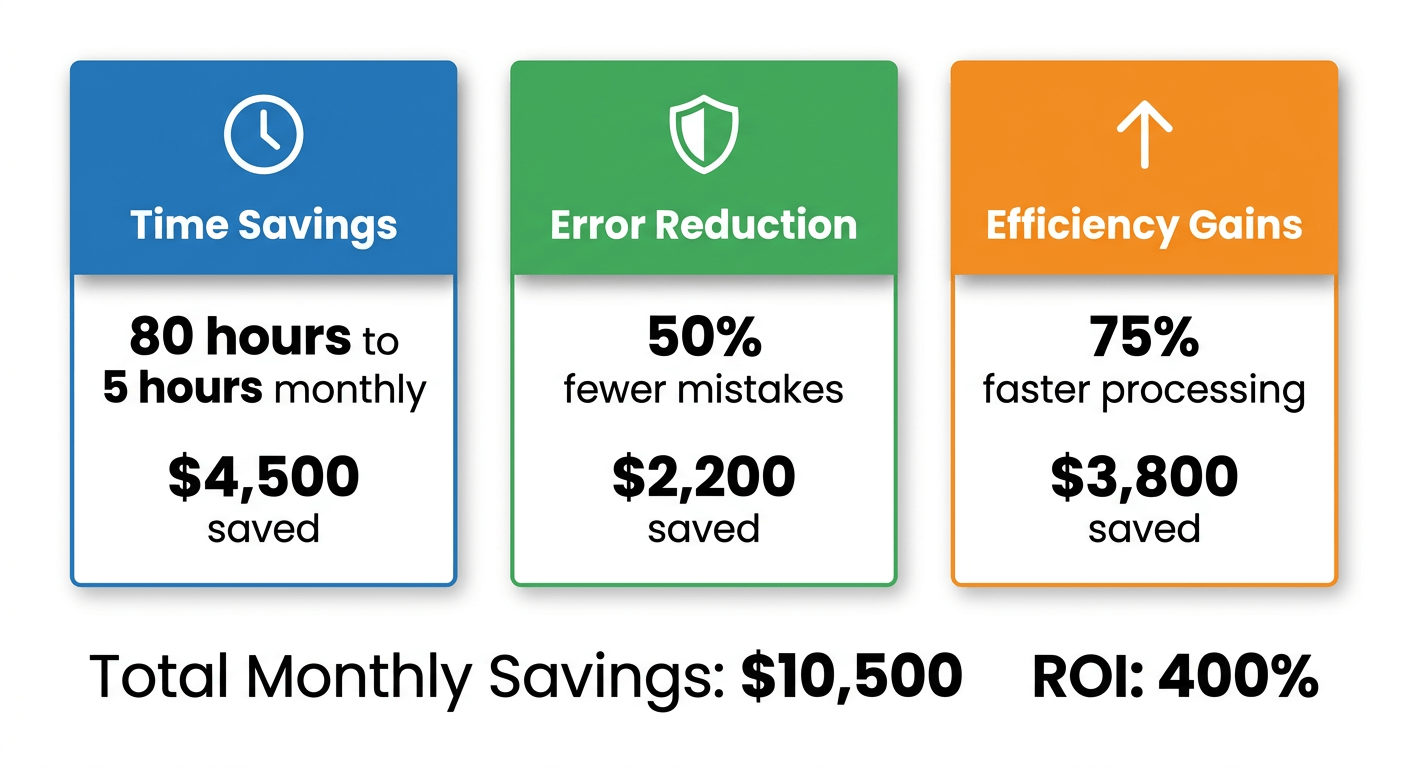
Begin with time savings calculations. If a manual process currently takes 10 hours weekly and automation can reduce this to 2 hours, you’re saving 8 hours per week, or 416 hours annually. Multiply by the hourly cost of whoever does this work, including not just salary but national insurance, pension contributions, and overhead costs.
Add error reduction benefits. If automation eliminates mistakes that currently cost $600 monthly to fix, that’s $7,500 annual savings. Include indirect costs like customer dissatisfaction or delayed projects caused by errors.
Consider capacity improvements. If automation frees up 10 hours weekly, that time can be redirected to revenue-generating activities. Calculate the potential value of those hours based on what your team typically produces.
Subtract all implementation costs: software licences, setup time, training, data preparation, and ongoing maintenance. Include a buffer for unexpected issues or learning curve delays.
Use a payback period calculation rather than trying to project benefits over multiple years. How long until the monthly savings exceed the monthly costs? Anything under 12 months is usually worthwhile, 12-24 months requires careful consideration, and anything longer needs compelling strategic justification.
Forrester’s 2024 study found that successful AI implementations in small businesses typically achieve payback within 6-18 months, with the fastest returns coming from process automation rather than predictive analytics or complex machine learning applications.
Be honest about soft benefits. Improved employee satisfaction from eliminating tedious work is valuable but difficult to quantify. Better customer experience from faster response times matters but might not translate to immediate revenue increases. Include these factors in your decision-making but don’t rely on them for ROI justification.
Common ROI Pitfalls to Avoid
The biggest mistake I see is overestimating how quickly AI will deliver results. Even straightforward automation projects require setup time, testing, and adjustment periods before they run smoothly.
Many businesses underestimate the data quality requirements. AI tools work best with clean, consistent data. If your current information is scattered across multiple systems, incomplete, or inconsistent, you’ll need to invest time cleaning it up before any AI solution can deliver promised benefits.
Another common error is implementing AI for processes that aren’t actually problems. Just because something can be automated doesn’t mean it should be. If a manual process works well, takes little time, or happens infrequently, automation might not provide meaningful returns.
Scale assumptions often prove unrealistic. A tool that works brilliantly for 100 customers monthly might struggle with 500. Factor in scalability limitations when calculating long-term benefits.
Integration complexity frequently exceeds expectations. Connecting new AI tools to existing systems often requires more time and potentially additional software than initially anticipated. Budget for integration costs from the beginning.
Training requirements are often underestimated. Even user-friendly AI tools require time to learn properly. Factor in reduced productivity during the learning period and ongoing training as features evolve.
Maintenance needs grow over time. What starts as a simple automated process might require increasingly complex rules and exceptions as your business evolves. Plan for ongoing optimisation time.
Strategic Implementation Approach
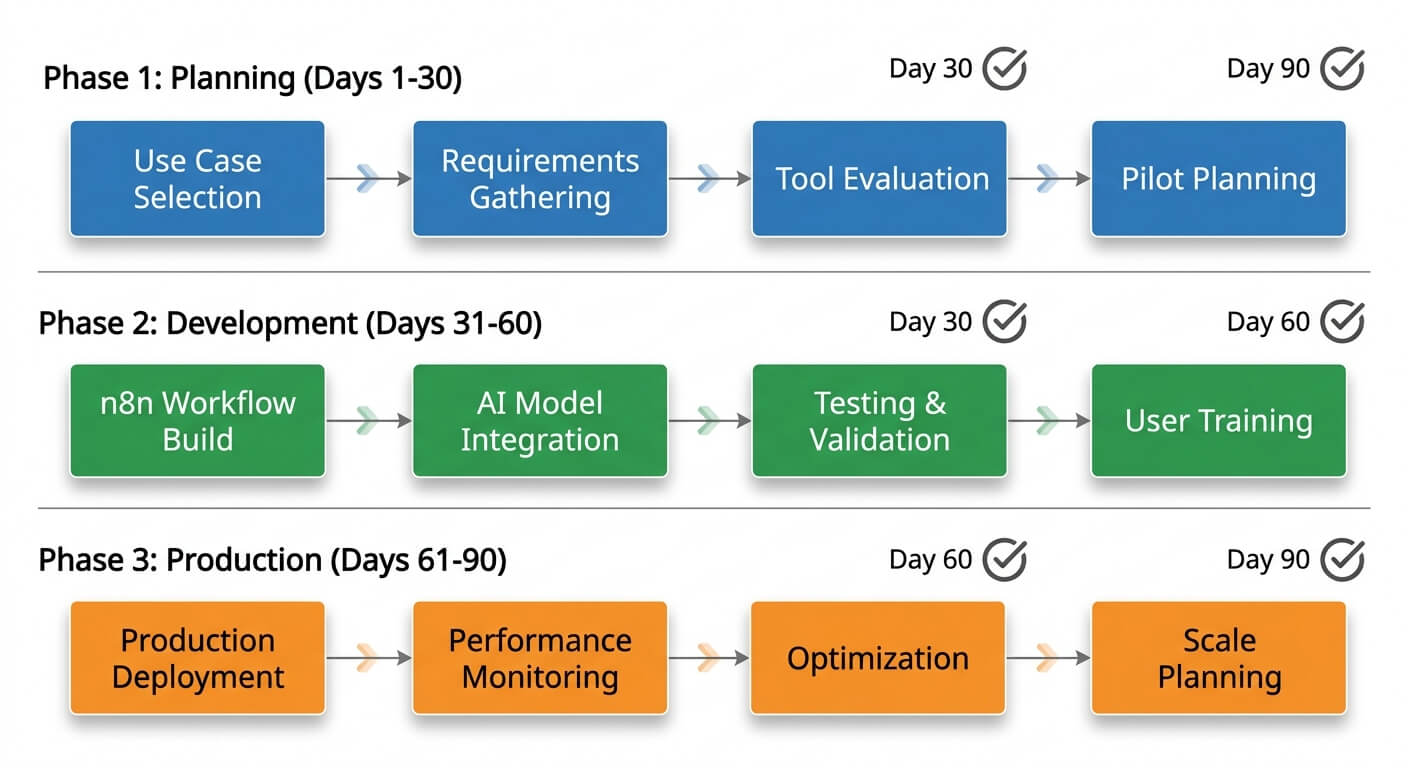
Successful AI implementation starts small and builds systematically. Choose one specific process that causes regular frustration, measure current costs accurately, and implement a solution that addresses just that problem.
Document everything during implementation. Track actual time spent on setup, note problems encountered, and measure results against predictions. This creates realistic baselines for future projects and helps refine your ROI calculations.
Involve your team in the selection and implementation process. They understand the current pain points better than any outside consultant and can identify potential problems before they become expensive mistakes. Their buy-in is essential for successful adoption.
Set realistic timelines. Most AI implementations take longer than expected, especially the first one. Build buffer time into your schedule and don’t commit to unrealistic deadlines that create pressure to skip important steps.
Plan for ongoing optimisation. Every AI system improves with use and adjustment. Schedule regular reviews to refine rules, update processes, and identify additional automation opportunities.
Consider starting with AI automation strategy consulting to ensure you’re focusing on the right processes. An experienced perspective can help avoid expensive mistakes and identify opportunities you might miss.
Building Long-term AI Value
The most successful small businesses treat AI implementation as an ongoing capability development rather than a one-time technology purchase. Each successful automation project builds knowledge and confidence for more complex implementations.
Start with processes that have clear, measurable outcomes. Success with straightforward automation creates momentum and justifies investment in more sophisticated solutions. Early wins also provide learning opportunities without major risk.
Develop internal expertise gradually. Rather than outsourcing everything, ensure someone in your organisation understands how your AI tools work and can make basic adjustments. This reduces ongoing costs and improves response time when issues arise.
Integration becomes increasingly important as you implement multiple AI solutions. Tools that work well individually might not communicate effectively with each other. Planning for system integration from early stages prevents expensive rework later.
Data quality improvements compound over time. Each process you automate provides an opportunity to clean up and standardise information. Better data makes all subsequent AI implementations more effective and faster to deploy.
Consider how process optimisation can prepare your business for AI implementation. Sometimes improving current processes manually first makes automation more straightforward and effective.
Making the Final Decision
The business case for AI comes down to simple mathematics: does it solve a real problem that costs more than the solution? Everything else is secondary.
Calculate your current costs honestly. Include time, errors, delays, and opportunity costs. Compare this to the total cost of implementation and operation over the first year. If the savings exceed the costs within 12 months, you probably have a viable case.
Consider your capacity to implement properly. Do you have time to set up and learn new systems? Can you invest the effort required for successful adoption? The best technology won’t help if you can’t implement it properly.
Evaluate your risk tolerance. Every new system carries implementation risk. Start with lower-risk projects that won’t disrupt critical business processes if something goes wrong.
Think about timing. Is this the right moment for your business to take on an AI project? Consider your current workload, upcoming commitments, and available resources.
The businesses that succeed with AI are those that approach it as a practical tool for solving specific problems, not as a transformation strategy. They calculate costs carefully, implement systematically, and measure results honestly.
AI pays off when it eliminates work you’d rather not do anyway, reduces errors that cost time and money to fix, or frees up capacity for activities that directly generate revenue. When you can measure those benefits clearly and they exceed implementation costs, the business case writes itself.
Frequently Asked Questions
How long does it typically take to see ROI from AI automation in a small business?
Most small businesses achieve payback within 6-18 months for well-chosen automation projects. High-frequency tasks like invoice processing or customer service automation often deliver measurable returns within the first quarter, whilst more complex implementations may require a full year. The key is starting with processes where manual costs are already high and automation benefits are immediate and measurable, rather than speculative long-term gains.
What’s the minimum business size that makes AI automation worthwhile?
There’s no specific revenue threshold, but rather a process frequency threshold. If you’re spending more than 5-10 hours weekly on repetitive tasks that follow consistent rules, automation likely makes financial sense regardless of business size. A sole trader spending 15 hours monthly on invoice chasing can benefit as much as a 50-person company, provided the implementation costs align with the time savings.
Should I automate multiple processes simultaneously or start with one?
Always start with a single, well-defined process. Implementing multiple AI solutions simultaneously divides your attention, complicates troubleshooting, and makes it impossible to accurately measure individual returns. Success with one automation builds knowledge and confidence for subsequent projects. Once your first implementation runs smoothly for at least three months, consider adding another process.
How do I know if my data is good enough for AI automation?
Your data is ready for automation if it’s consistently formatted, reasonably complete, and stored in accessible systems. If you can currently generate reports or analyse trends from your data manually, it’s probably suitable for automation. Warning signs include frequent duplicate entries, inconsistent naming conventions, or information scattered across multiple disconnected systems. Budget time for data cleaning before implementation rather than discovering problems mid-project.
What happens if an AI automation project fails to deliver expected returns?
Failed automation projects usually result from poor process selection rather than technology limitations. If returns fall short, first verify you accurately calculated baseline costs and didn’t overestimate time savings. Consider whether the process needed optimisation before automation, or whether staff require additional training. Sometimes the right decision is to abandon an automation that isn’t working and redirect resources to a different process with clearer benefits. Document what you learned to improve future project selection.
What is the biggest mistake SMBs make when considering AI?
Small businesses often approach AI backwards, starting with the technology rather than identifying genuine business pain points first. They underestimate the true costs beyond software licences, failing to account for essential human time needed for learning, data cleaning, and ongoing system maintenance. This leads to abandoned projects before any return on investment is realised.
What hidden costs should small businesses budget for with AI?
Beyond the software licence, small businesses must budget for significant human time. This includes learning the system, team training, and crucial data cleaning before implementation. Ongoing expenses like data maintenance, regular software updates, and periodic optimisation are also vital to factor in from the outset to ensure sustained effectiveness and avoid unwelcome surprises.
How can I calculate the true cost of my business’s inefficiencies?
To calculate inefficiency costs, track time spent on repetitive tasks, measure error rates, and quantify delays. For example, determine hours spent on manual invoice chasing or data entry. Remember to factor in indirect costs too, such as lost opportunities, cash flow impact from late payments, or customer service time spent correcting mistakes.