Computer Vision for Small Manufacturers: Practical Applications That Cut Waste and Boost Quality
Discover computer vision for small manufacturers practical applications that cut defects, reduce waste, and boost quality without enterprise budgets.
Contents
What Small Manufacturers Actually Gain from Visual AI
Small manufacturers using computer vision for quality inspection report defect detection rates above 95%, compared to 70-80% for manual visual checks. These systems catch flaws the human eye misses, particularly during repetitive tasks over long shifts. The technology costs between $15,000 and $50,000 to implement, putting it within reach for operations with annual revenues above $2 million.
Here’s what surprises most small manufacturing owners: computer vision for small manufacturers isn’t new technology reserved for automotive giants. The same systems that Toyota uses to inspect welds now run on hardware costing less than a CNC machine upgrade. Cameras, edge computing devices, and pre-trained AI models have dropped in price by roughly 60% since 2022.
The real question isn’t whether you can afford computer vision. It’s whether you can afford the scrap rates, rework costs, and customer complaints that come from purely manual inspection.

Quality Inspection That Never Blinks or Gets Tired
Small manufacturers see even higher improvements because they often start from a baseline of informal, inconsistent inspection processes.
Manual inspection has an obvious flaw. Humans get tired. By hour six of a shift, even your best inspector misses defects they would have caught at hour one. Fatigue, distraction, and simple boredom cause inspection accuracy to drop by 20-30% over an eight-hour shift.
Computer vision systems maintain the same accuracy at hour eight as they did at minute one. They examine every single part with identical scrutiny.
Surface Defect Detection
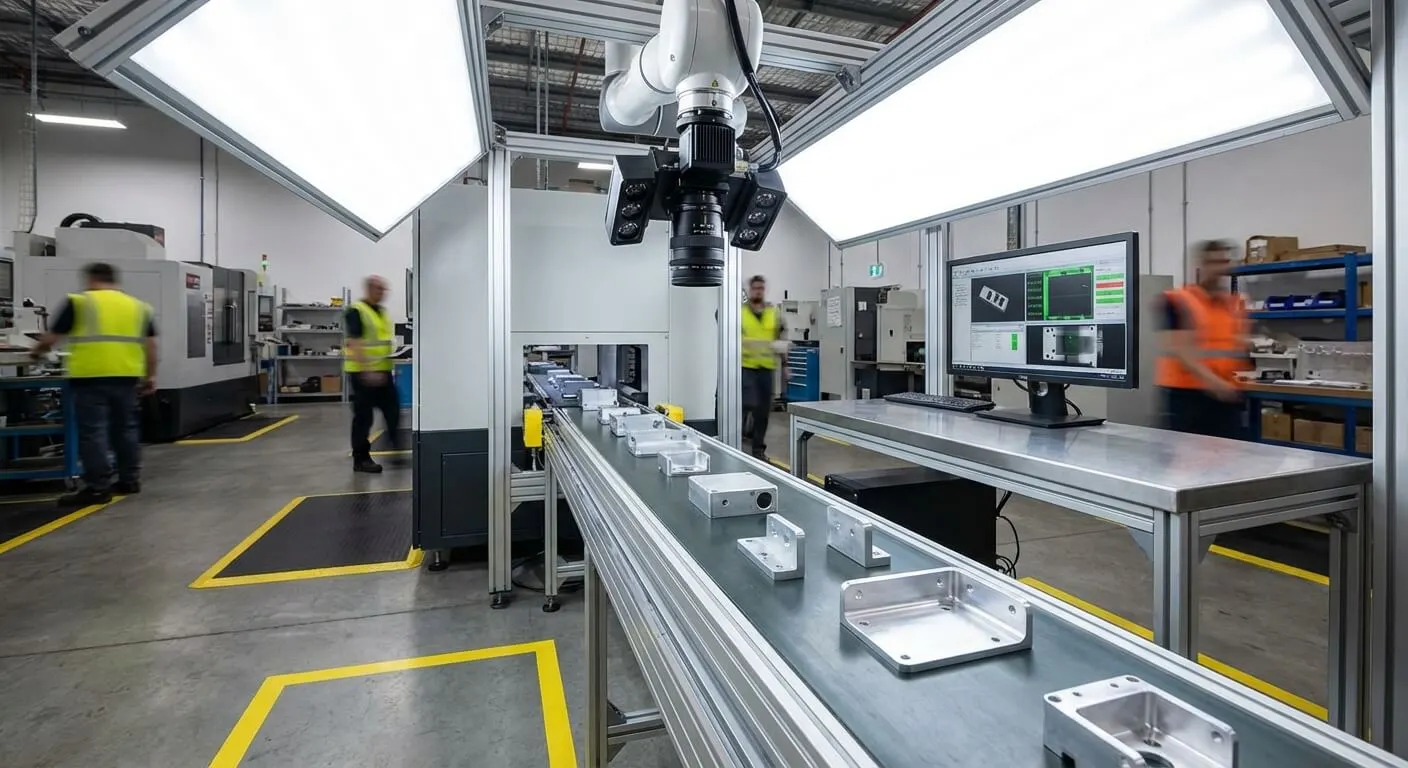
Surface scratches, dents, and discolouration are the bread and butter of visual inspection. A camera system trained on your specific products learns what “good” looks like. Then it flags anything that deviates from that standard.
For a metal fabrication shop, this might mean catching tool marks before parts ship. For a plastics manufacturer, it could mean spotting sink marks or flash that indicates process problems. The system doesn’t just find defects. It creates a data trail that helps you trace quality issues back to specific machines, shifts, or material batches.
Dimensional Verification
Measuring parts manually slows production. Measuring every part manually stops production entirely. Computer vision combined with precision cameras can verify dimensions on moving parts at production speed.
One client I’ve worked with in precision machining cut their dimensional inspection time from 45 seconds per part to under 2 seconds. They now inspect 100% of output instead of sampling 10%.
Inventory Counting Without the Clipboard
Manual inventory counts tend to be error-prone in manufacturing environments with high SKU counts. Camera-based counting systems reach 98% accuracy while eliminating hours of manual counting.
Small manufacturers often track inventory with spreadsheets, memory, and monthly panic counts. This creates chronic issues. You order materials you already have. You run out of components nobody realised were low. Production stops while someone hunts for parts that should be on the shelf.
Computer vision changes this dynamic. Cameras mounted above bins and storage areas track quantities in real-time. The system knows when stock drops below reorder points. It alerts you before shortages happen.
Bin Level Monitoring
The simplest application uses cameras pointed at storage bins. The system estimates quantity based on how full each bin appears. This works surprisingly well for standardised components like fasteners, brackets, and small parts.
More sophisticated setups use weight sensors combined with visual confirmation. The camera verifies what the scale measures, preventing errors from mixed parts or foreign objects in bins.
Receiving Verification
When shipments arrive, computer vision can count incoming items and match them against purchase orders. This catches short shipments immediately rather than discovering the problem mid-production. It also builds a visual record that proves what actually arrived, useful when disputing supplier invoices.
If you’re building automated purchasing workflows, connecting your inventory systems to your accounting platform prevents the cascade of manual updates that usually follows receiving.
Workplace Safety Monitoring in real-time
The Occupational Safety and Health Administration reports that manufacturing accounts for 15% of all workplace injuries despite employing only 8% of the workforce. Computer vision safety systems reduce recordable incidents by 35-50% by catching hazards before they cause harm.
Safety inspections happen periodically. Accidents happen constantly. Computer vision bridges this gap by monitoring work areas continuously for unsafe conditions.
PPE Compliance Detection
Cameras can verify that workers wear required protective equipment in designated zones. Hard hats, safety glasses, high-visibility vests, and hearing protection all have visual signatures that trained models recognise.
The system alerts supervisors when someone enters a zone without proper equipment. More importantly, it creates compliance data that satisfies auditors and insurers. You prove your safety programme works, not just that you have a policy.
Restricted Zone Monitoring
Certain areas near heavy machinery require lockout procedures. Computer vision tracks whether people enter these zones during operation. It can trigger automatic shutdowns or alarms before accidents occur.
This matters for small manufacturers who can’t afford full-time safety officers watching every corner of the shop floor. The cameras watch instead.

Process Optimisation Through Visual Data
You can’t improve what you can’t measure. Most small manufacturers have limited visibility into what actually happens on the floor minute by minute. Computer vision fills this gap, surfacing the gains that come from identifying bottlenecks invisible to periodic observation.
Cycle Time Analysis
Cameras watching workstations capture how long each operation actually takes. Not the standard time. Not the estimate. The real duration.
This data reveals variation you didn’t know existed. Maybe one operator takes twice as long as another for the same task. Maybe certain parts cause consistent slowdowns. You can’t address these issues if you don’t see them.
Motion and Flow Studies
Old-fashioned time and motion studies required someone standing with a stopwatch. Computer vision automates this entirely. The system tracks movement patterns, identifies wasted motion, and highlights inefficient layouts.
One manufacturing business I helped discovered that operators walked an average of 2.3 miles per shift retrieving tools and materials. Reorganising the floor based on visual data cut that distance by 40%, adding productive capacity without hiring.
Equipment Utilisation
Cameras pointed at machines track actual running time versus idle time. You might assume your expensive CNC runs 80% of the shift. Visual data might reveal it actually runs 55%, with the rest lost to setup, loading, and operator absence.
This connects directly to building a business case for automation investments. Hard data on current utilisation makes ROI calculations credible rather than speculative.
Getting Started Without Enterprise Resources
Starting small with a single high-value application delivers faster results and builds internal expertise.
You don’t need to wire your entire facility with cameras on day one. Start with one problem. Solve it. Learn from it. Then expand.
Choose Your First Application
Pick something with clear, measurable value. Common starting points include:
- Final inspection on your highest-volume product line
- Counting a chronic problem item in inventory
- Monitoring one safety-critical zone
- Tracking cycle times on a bottleneck operation
Avoid the temptation to build a comprehensive system from scratch. That path leads to eighteen months of development and nothing in production.
Hardware Considerations
Industrial cameras designed for manufacturing environments cost between $500 and $3,000 depending on resolution and durability. You need proper lighting, which often matters more than camera quality. Edge computing devices that run AI models locally start around $1,000.
Cloud-based processing is an alternative that reduces upfront hardware costs. The tradeoff is ongoing subscription fees and potential latency issues. For real-time inspection, edge processing usually makes more sense.
Software and Integration
Pre-trained models for common inspection tasks exist from multiple vendors. These get you started faster than building custom models from scratch. Expect to spend $5,000 to $15,000 on software licensing or development for a first application.
Integration with existing systems matters. Your vision system should feed data into your MES, ERP, or quality management software. If you’re still running on spreadsheets, this is a good time to consider upgrading your tech stack alongside the vision project.
The Counterintuitive Truth About Implementation
Here’s what most vendors won’t tell you: the camera and AI are the easy parts. The hard work is lighting, mounting, and process discipline.
Poor lighting ruins even the best camera system. Inconsistent part positioning means the system sees different angles every time. Dirty lenses, vibration, and environmental dust cause false rejects.
Spend 60% of your implementation budget on the physical setup. Lighting rigs, mounting hardware, and environmental controls matter more than megapixels.
Also, expect a learning period. New systems generate false positives. They require tuning. Your team needs time to trust the technology. Budget three to six months from installation to full confidence.
Frequently Asked Questions
How much does computer vision cost for a small manufacturing operation?
A basic single-station inspection system runs between $15,000 and $30,000 including hardware, software, and installation. Facility-wide implementations range from $50,000 to $150,000 depending on scope. Most manufacturers see payback within 12 to 18 months through reduced scrap, rework, and labour costs.
Do I need specialised IT staff to run computer vision systems?
Modern systems are designed for operators, not data scientists. After initial setup by specialists, daily operation typically requires only basic training. Your quality or maintenance team can handle routine tasks. Technical support from vendors covers software updates and model retraining.
Will computer vision replace my quality inspectors?
Rarely. Most implementations augment human inspectors rather than replacing them. The system handles repetitive visual checks at high speed. Human inspectors focus on complex judgment calls, customer-specific requirements, and managing exceptions the system flags.
How long does implementation take from decision to production use?
A focused single-application project takes eight to twelve weeks from hardware order to reliable production operation. This includes equipment delivery, installation, training the model on your specific products, and tuning to reduce false positives. Rushing this timeline usually creates problems.
What industries benefit most from visual AI in manufacturing?
Metal fabrication, plastics moulding, food packaging, and electronics assembly see the fastest returns. Any operation with high-volume, visually similar products and measurable defect rates is a strong candidate. Low-volume custom work benefits less because training models for each product takes time.