How Recruitment Agencies Use AI to Automate Candidate Matching
How AI candidate matching actually works for recruitment agencies, where it helps, where it does not, and what to check before you buy.
Contents
AI candidate matching targets the screening stage. It reads job requirements and candidate profiles for meaning rather than keywords, ranks applicants, and hands the recruiter a shortlist with reasoning attached. What follows is how it works, where it genuinely helps, and where the sales pitch outruns the evidence.
Screening is the part of recruitment nobody defends. A role opens, applications arrive in bulk, and a consultant works through them one at a time looking for reasons to say no. It is slow, it is inconsistent between consultants, and it is the stage where good candidates are lost to whoever called them first.
A note on the numbers you will see elsewhere
Vendor material for this category is full of precise-sounding claims: sixty per cent faster hiring, so many hours saved per role, a particular accuracy rate. I am not going to repeat them, because I cannot verify them and neither can you. They almost always trace back to a vendor’s own case study with no methodology attached, or to a figure that has been repeated so often the original source has disappeared.
What I can tell you is the mechanism, the failure modes, and what to measure in your own agency, which is more useful than a number invented for a slide.
Why traditional ATS matching falls short
Most agencies already run an applicant tracking system. It organises candidates and tracks progress well enough. The matching, though, is usually keyword-based: it looks for exact phrases and rejects candidates who describe the same skill differently.
A project manager who writes “leading cross-functional initiatives” rather than “project management” is invisible to that search. Meanwhile a candidate who has stuffed their CV with the right words sails through. You end up interviewing the wrong people while qualified ones never reach your desk.
Semantic matching works differently. It reads for meaning, so it recognises that “managed P&L responsibility” is evidence of financial acumen even when the word finance never appears, and that a Customer Success Manager at a startup may be doing the job an enterprise calls Account Director.
What the technology actually does
Three things, in practice.
It parses inconsistently formatted documents. CVs arrive as PDFs, Word files and LinkedIn exports. Extracting structured data from all of them reliably is unglamorous and genuinely hard, and it is most of the value.
It infers skills rather than reading them off a list. When a candidate writes “built and managed a remote team of twelve across three time zones”, a good system infers remote management, cross-cultural communication and scheduling complexity. None of those words appear. That inference is what widens a shortlist beyond the obvious applicants.
It quantifies gaps instead of rejecting on them. A candidate with eight years where you asked for ten, but with markedly more complex project exposure, gets flagged with the trade-off made explicit. That is a more honest conversation to have with a client than a silent rejection.
Where it works, and where it does not
Here is the part most vendors skip. AI matching works best for roles you fill repeatedly, because it learns from your own placement history. An agency placing software developers every month has the volume and the outcome data for the system to learn from.
Executive search is a different proposition. Novel or senior roles come with little historical data, and the matching component has less to work with. AI still helps there, but with discovery and outreach rather than ranking. The judgement stays human.
So assess your own role portfolio honestly before buying. Where do you have volume and clean outcome records? That is where this pays. If your work is mostly bespoke senior placements, expect the benefit to arrive somewhere other than the shortlist.
Your data decides the outcome
AI matching learns from your historical placements, which means it inherits whatever is in your ATS. Incomplete records, inconsistent job titles and missing outcome data all degrade it, and no amount of vendor configuration compensates.
Before implementing anything, do two unglamorous jobs. Normalise your existing records so the same role is described the same way. Then define what “good” looked like for your highest-volume roles: which placements exceeded client expectations, and what those candidates had in common. That analysis is useful on its own, and it is frequently uncomfortable, because what predicts success is often not what clients say they want.
Connecting it to what you already run
Your ATS holds candidates, your CRM holds client relationships, job boards generate applications. Matching has to reach all of them, and that integration work is usually where projects stall.
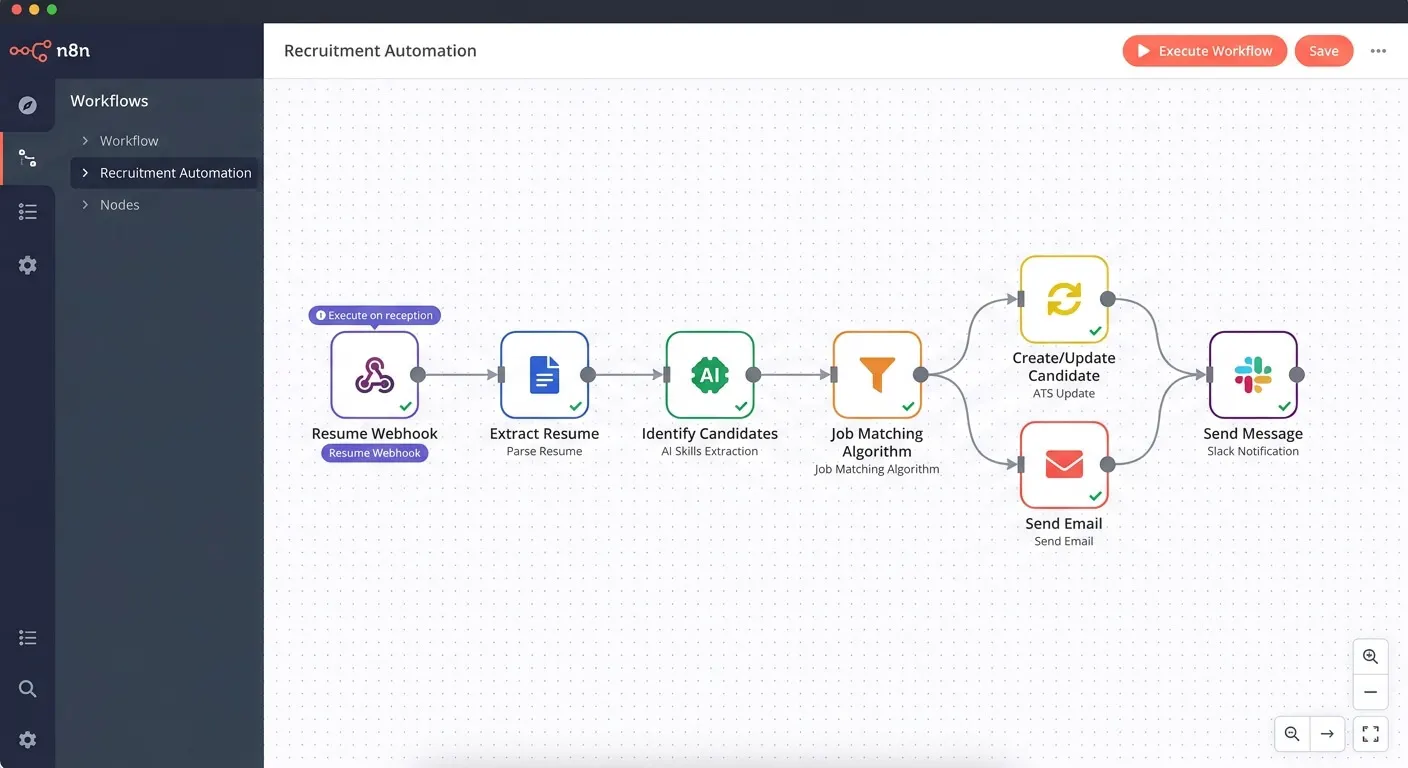
Tools like Zapier and n8n connect these systems without custom development. A workable pattern: an application lands in the ATS, triggers analysis, scores the candidate, writes the score back to their record, and notifies the assigned consultant when it clears your threshold.
The point of automating the trigger is consistency. A tool your recruiters have to remember to run gets used on busy days and skipped on busier ones, which is precisely backwards.
Getting recruiters to trust it
Consultants resist these tools, and the resistance is reasonable. They have built careers on judging people, and a machine claiming to do it better is not a welcome message.
Transparency is what shifts it. A system that reports “92% match” and nothing else invites suspicion. One that shows which skills aligned, which experience correlated with past success, and where the candidate differs from the brief gives the recruiter something to use in a client conversation. The tool stops being a verdict and becomes evidence.
I have written separately about overcoming team resistance to AI tools. The short version: position it as augmentation, and make sure the work it frees up is work your consultants actually prefer.
What to measure
Time-to-hire is the headline metric and the least informative on its own. Track these alongside it:
- Placement retention. Do AI-shortlisted candidates stay longer than manually screened ones? This is the metric that tells you whether matching quality improved or you simply got faster at the same decisions.
- Placements per consultant per month. If screening time falls and this does not rise, the time went somewhere else and the process needs looking at.
- Client satisfaction. Speed that costs quality damages relationships faster than slow shortlists do.
Measure all of these before you deploy, or you will have nothing to compare against. That baseline is the single most common omission I see, and without it every later claim about improvement is unfalsifiable.
For a general framework, my business process automation ROI calculator applies to recruitment as well as to other operations.
What this means for your agency
Agencies face real pressure from in-house talent teams and from job boards selling direct access. The ones that hold ground will be those doing what an unaided human recruiter cannot: reviewing every applicant consistently, at speed, without the twentieth CV getting less attention than the second.
That is the honest case for AI matching. Not that it replaces judgement, but that it removes the part of the job where judgement was never being applied properly anyway, because nobody can read two hundred CVs with equal care.
Frequently asked questions
How much does AI candidate matching software cost?
Pricing varies widely by volume and by whether matching is bundled into an ATS or bought separately, and published pricing in this category is scarce. Rather than work from a headline figure, calculate what screening currently costs you in consultant hours, and use that to judge any quote you receive.
Will it work with our existing applicant tracking system?
Many tools integrate with the common ATS platforms through APIs or pre-built connectors, but check for your specific system before committing. Where there is no direct integration, middleware such as n8n or Zapier can bridge it. Running matching alongside your ATS rather than replacing it is a reasonable first step.
How long before we see results?
Screening time usually changes quickly, because that part is mechanical. Matching quality takes longer, since the system needs enough of your own placement outcomes to learn from, and that depends on your data being clean and your volume being sufficient. Be sceptical of any timeline quoted before the vendor has seen your records.
Does AI matching introduce bias?
It can. A system trained on biased historical placements will reproduce those patterns, and do it at scale and with an air of objectivity, which is worse than a biased human because it is harder to challenge. Properly configured, it can also reduce bias by applying consistent criteria and surfacing candidates from non-traditional backgrounds. The difference is entirely in whether you audit the training data and monitor outcomes across groups. Treat any vendor who describes their system as inherently unbiased as a vendor to avoid.